Travel cot, playpen or travel crib: the differences that matter
Nursery aisles mix up names and uses. Here is how to tell a travel cot from a playpen, a travel crib or a bedside sleeper, and how to avoid buying two products that do the same job.
Contents
Why it gets confusing
“Travel cot”, “travel bed”, “folding cot”, “playpen”, “travel crib”, “3-in-1” or “4-in-1 cot”: product pages use these words interchangeably. The same product can be sold under three names depending on the website. And the product families overlap: many travel cots double as playpens, some playpens are not designed for sleep, some cribs fold.
The right approach is to look at three things: what the product is mainly for (sleeping or playing), from when to when it is used (first months or up to 3 years), and how it travels. The name comes after.
The classic travel cot
This is the original design: a jointed metal frame, sides in fabric and mesh, and a rigid base on which a thin mattress sits. It folds by pulling the centre of the base upwards, forming a bundle that slides into a bag. Its sleeping area is often 60 x 120 cm, like a standard cot.
Strengths
- Large sleeping area, up to about 3 years
- Standard sheets easy to find
- Also works as a playpen during the day
- Wide choice of models
Limits
- Mattress at the bottom, almost on the floor
- Folding sometimes confusing at first
- Folded bundle thick and often heavy
- Not very decorative
Some models add a bassinet insert for the first months, a changing table or wheels. These options make the cot heavier: choose them only if you will really use them.
The 4-in-1 folding cot
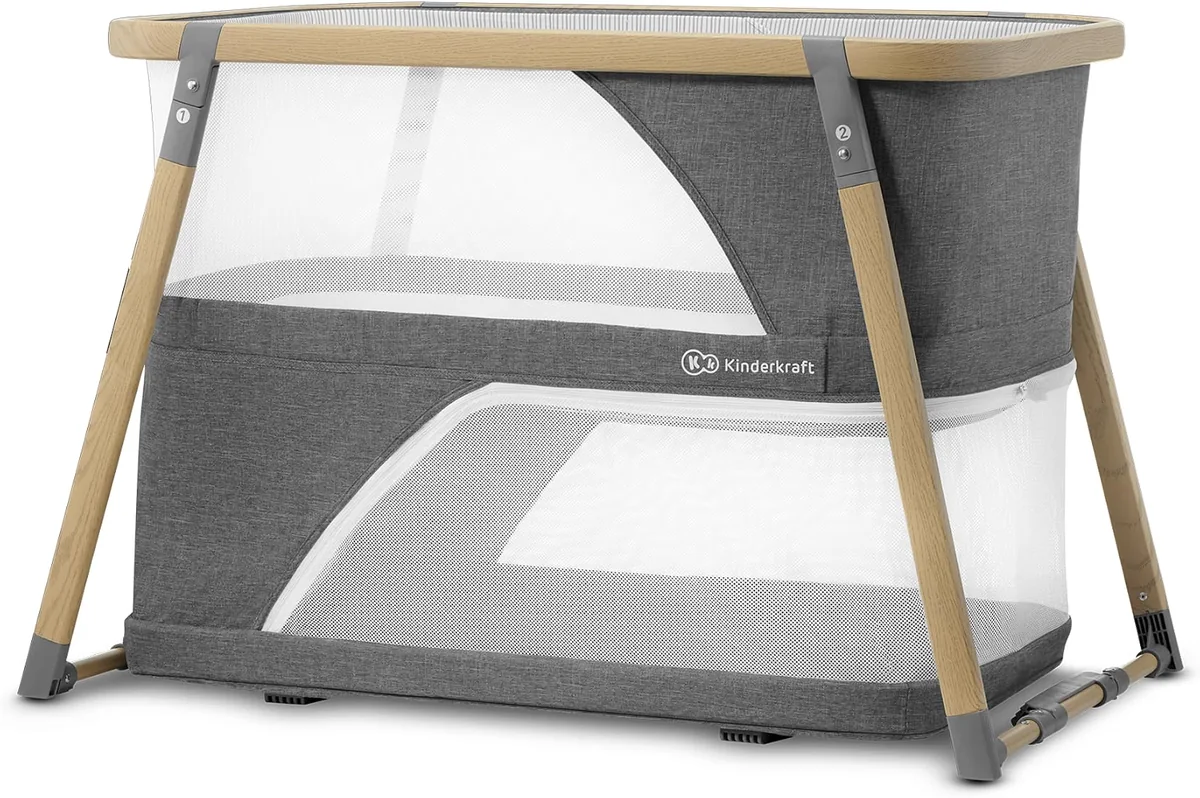
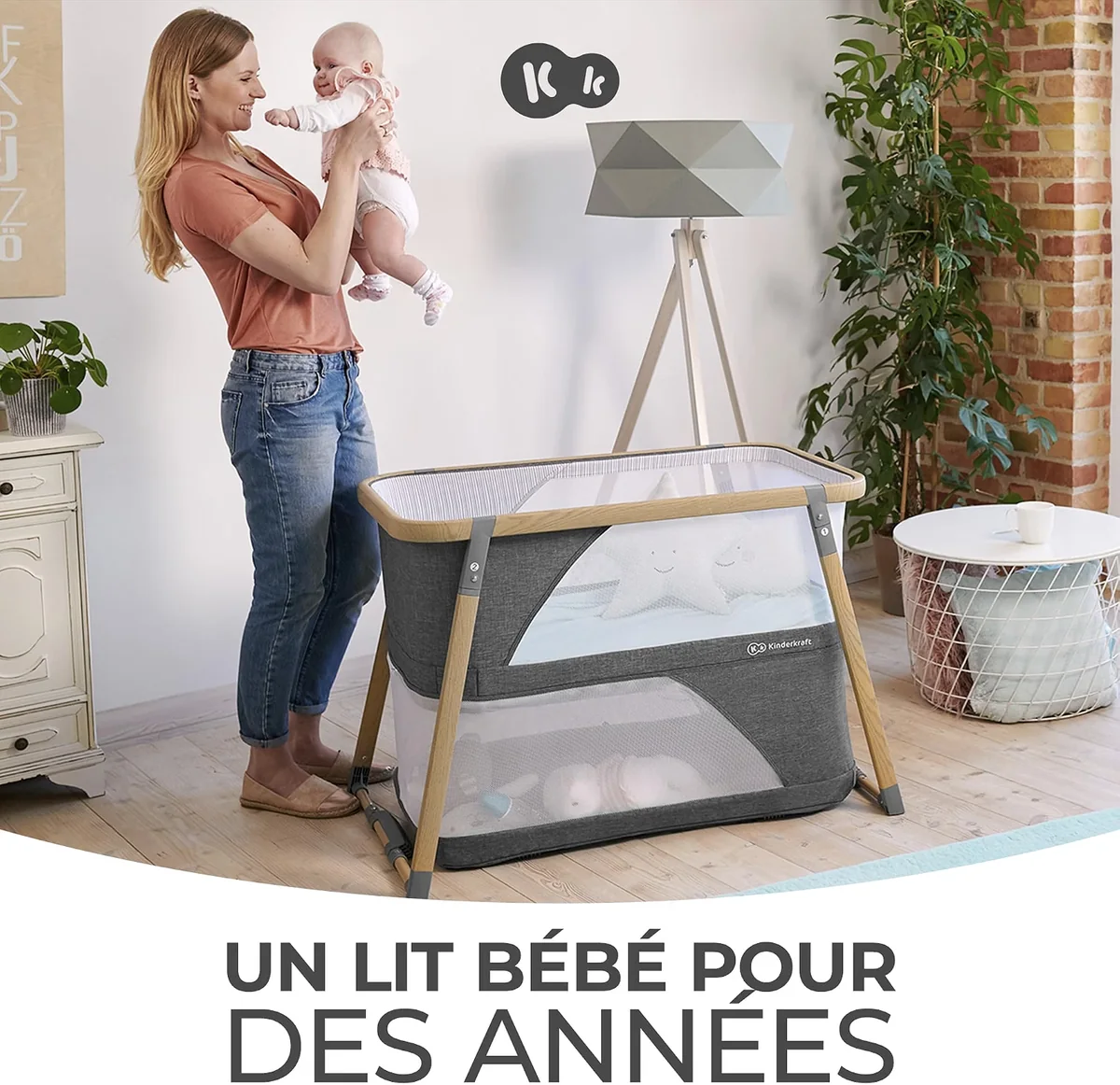
This is the newest family. These cots combine a bedroom cot with a raised mattress, a travel cot, a playpen and often a rocking crib. They frequently fold flat, like the Kinderkraft Sofi, and pay attention to their looks so they fit into a parents’ bedroom.
Their strength is continuity: a single cot from the maternity ward up to about 15 kg, at home and away. Their weakness is often the size of the sleeping area, sometimes more compact than the standard, and their weight, around 8 to 9 kg. The Sofi, for example, has a mattress of about 91 x 52 cm and weighs 8.7 kg according to Kinderkraft.
The ultralight travel cot
Designed for flying and small spaces, it bets everything on weight and compactness: often around 6 kg or less, with a very compact fold. Some well-known models are sold with no weight limit, until the child starts climbing to get out. The sleeping surface is often at the bottom, and the lightest models are expensive.
If you fly several times a year, this is the family to look at. For use mainly by car or at home, a 4-in-1 cot or a classic travel cot offers more functions for the same boot space.
The playpen
A playpen is first of all a safe play space: the child plays while you cook or hang out the washing. It has its own standard, EN 12227, which covers playpens for domestic use. Some playpens are not designed for sleep: their instructions say so. Others, square and larger than cots, give more room to play but less mobility.
Many travel cots work as a playpen during the day, with the mattress at the bottom. If a cot lists both standards, EN 716 for sleep and EN 12227 for play, it can replace a separate playpen in most homes.
Crib, Moses basket and bedside sleeper
These only serve the first months. A crib or Moses basket is small, often set on a stand, with a low weight limit. A bedside sleeper is a crib designed to attach to the parents’ bed, with one side that lowers; it only attaches to the parents’ bed if it is designed for that.
A 4-in-1 folding cot with a raised level and rocking does part of the same job as a crib, with a much longer lifespan. It does not attach to the parents’ bed: it stands beside it. If you are set on a bedside sleeper for night feeds, a real bedside sleeper remains better suited to the first months.
What the standards say
Two European standards shape this market:
- EN 716 (parts 1 and 2): cots and folding cots for domestic use. This is the sleep standard.
- EN 12227: playpens for domestic use. This is the play standard.
A product that is both a cot and a playpen should ideally list both. Kinderkraft gives EN 716-1:2017 and EN 12227:2010 for the Sofi. Whatever the family, check for clear manufacturer details and instructions in English.
The comparison table
| Criterion | Classic travel cot | 4-in-1 folding cot | Ultralight travel cot | Playpen | Crib / bedside sleeper |
|---|---|---|---|---|---|
| Main use | Sleeping, playing | Sleeping, playing, rocking | Sleeping while travelling | Playing | Sleeping |
| Lifespan | Birth to ~3 years | Birth to ~15 kg | Varies | See instructions | First months |
| Raised level | Option on some | Often | Rare | No | High sleeping surface |
| Transport | Car | Car | Plane, car | Not very mobile | Depends on model |
| Standard | EN 716 | EN 716, often EN 12227 | EN 716 | EN 12227 | Crib standards |
The lifespans and features in this table are general trends: each model has its own limits, given in its instructions.
Avoiding duplicates
A typical baby list quickly piles up a crib, a full-size cot, a travel cot and a playpen. Four products for three uses. Some leaner combinations:
- 4-in-1 folding cot + child’s bed later: the 4-in-1 acts as crib, bedroom cot, playpen and travel cot for the first year and beyond, then the child’s bed takes over.
- Full-size cot + ultralight travel cot: for families who fly a lot.
- Bedside sleeper + classic travel cot: for those who want a bedside sleeper for the first months and a large spare cot afterwards.
Before buying, list the real uses of your first year: where baby will sleep, where they will play, where you will travel. The right equipment covers those uses without overlap.
Five families, five choices
- City flat, small parents’ bedroom, weekends by car. A compact 4-in-1 folding cot that works as a crib and then as a travel cot.
- House, nursery ready, two weeks’ holiday a year. A full-size cot at home, a classic travel cot for holidays.
- Expat parents, three return flights a year. An ultralight travel cot, and a fixed cot at home.
- Grandparents who look after baby every week. A simple, stable cot that stays set up at their home, with a large sleeping area if the child will sleep there until age 3.
- An 18-month-old who needs a safe play space. A cot that works as a playpen with a side opening, or a dedicated playpen if you have the room.
The question of space
The choice between these products depends a lot on the space you have, both set up and folded. A classic 60 x 120 cm travel cot takes up about as much floor space as a full-size cot. A more compact 4-in-1 folding cot, like the Sofi (107 x 63 cm when open, according to Kinderkraft), fits more easily alongside a parents’ bed. A square playpen often covers a large floor area, which is its benefit for play and its drawback in a small living room.
Folded, the ranking changes: the classic travel cot forms a short, thick bundle, the flat-folding 4-in-1 a long, thin slab, the ultralight cot a small package. Measure the place where the cot will live: boot, cupboard, under a bed. Our calculator compares the folded Sofi with your space.
How needs change
A child’s needs change quickly during the first three years, and that is what makes the choice difficult:
| Approximate age | Main need | Best-suited product |
|---|---|---|
| About 0 to 4 months | Sleeping close to the parents, easy to reach | Crib, bedside sleeper or folding cot with raised level |
| About 4 to 12 months | Deeper sleeping space, safe play area | Full-size cot, folding cot on low level, playpen |
| About 1 to 3 years | Larger sleeping area, spare cot for trips | Child’s bed, classic travel cot |
These ages are only a guide: the child’s motor skills and the manufacturer’s weight limit decide. A cot that covers several rows of the table, like a 4-in-1 folding cot, saves you buying one product per stage.
And the full-size cot?
A traditional cot with bars, usually 60 x 120 cm, is still the reference bed for a child’s room. It has a thicker mattress, often several base heights and, on some models, sides that convert it into a toddler bed. If your child will have their own room from about six months and you rarely travel, a full-size cot plus a classic travel cot for trips is a sound pairing. If space is tight or you want to keep baby in your room for longer, a 4-in-1 folding cot can cover the first year on its own, and you move straight to a child’s bed later. What you should avoid is buying a cot, a crib and a 4-in-1 that will all be used during the same months.
Two homes, one cot?
When a child regularly sleeps in two homes, for example with separated parents or with a grandparent who helps every week, the question is whether to move one cot back and forth or to have one in each place. A single cot that travels keeps the same familiar sleeping space, but has to be folded, carried and checked every time. Two cots avoid the transport and the risk of forgetting a part, but the child changes sleeping surface. Many families choose two simple, identical models, so the gestures and the sheets are the same in both homes.
Before buying: the questions to ask
- Where will baby sleep for the first six months? If it is in your room, a raised level is precious.
- Do you need a separate play space? If so, a cot that works as a playpen may be enough.
- How do you travel? Car, train, plane: the weight and folded size depend on it.
- Will the cot stay at someone else’s home? Grandparents, childminder: simplicity comes first.
- Up to what age do you plan to use it? One year, or up to 3 years?
- What equipment do you already have? Avoid doubling up with an existing crib, cot or playpen.
The answers point to the right product. Our complete guide then goes through the technical criteria.
New, second-hand or borrowed?
Travel cots, playpens and cribs are passed around a lot between families. That is a good way to avoid duplicates. For a second-hand or borrowed product, whatever its family, check that it is complete with its instructions, that the mattress is the original one, that the locking is firm and the mesh intact, and that it has not been recalled: look on the EU Safety Gate portal or your national product safety authority’s recall list. A crib or playpen with no reference, or repaired at home, is not a bargain. For use from birth in your room, a recent cot with a raised level is often still the most comfortable choice.
The Sofi: a bit of everything
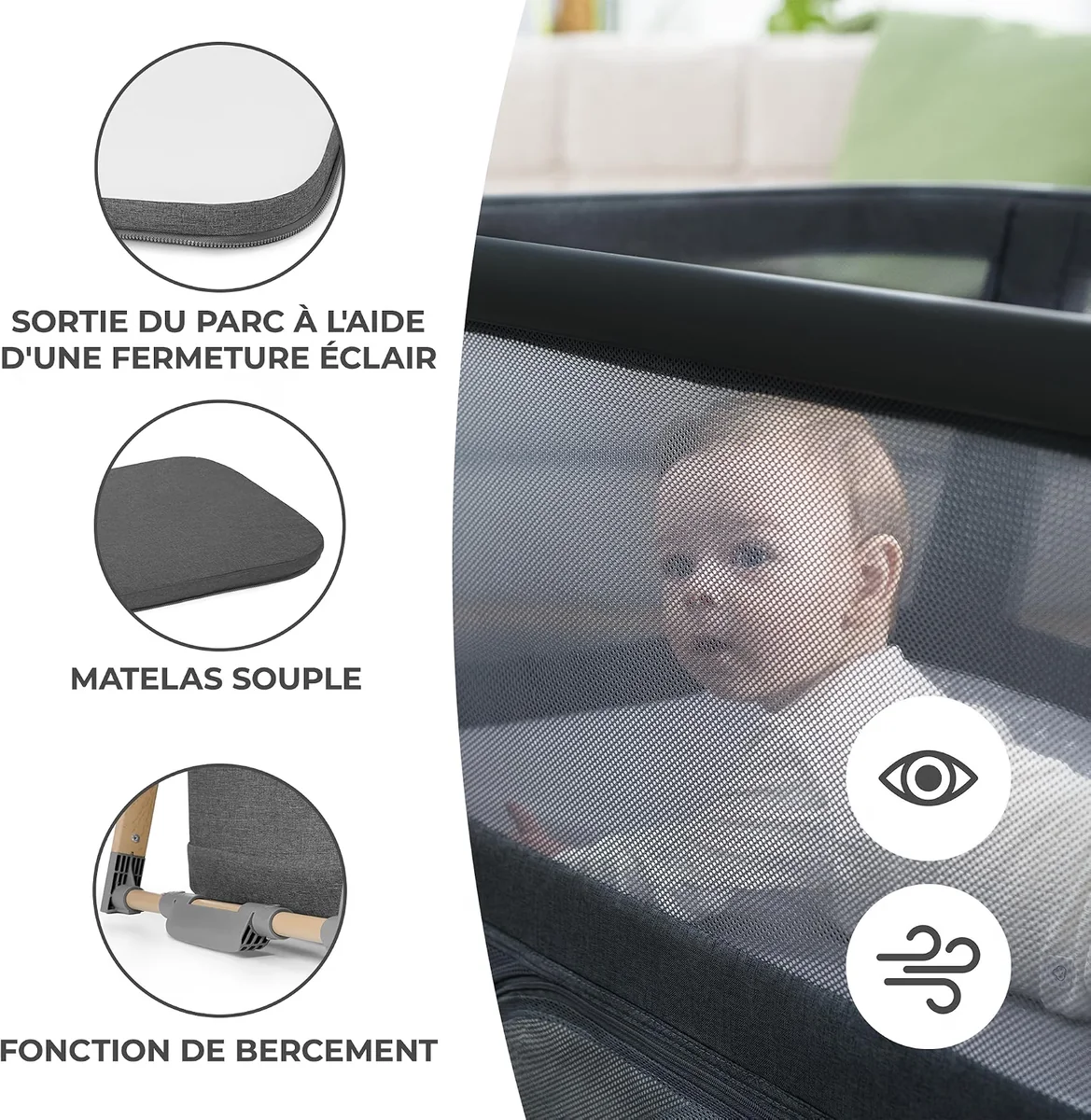
The Kinderkraft Sofi ticks four boxes: crib thanks to its raised level and rocking, bedroom cot thanks to its low level, playpen thanks to its zipped opening, travel cot thanks to its flat fold and bag. It does not replace a large 60 x 120 cm travel cot for a 3-year-old, or an ultralight cot for flying. It is the right choice if you want a single product for the first year and for weekends. Our guide to choosing a travel cot will help you confirm.
Frequently asked questions
Can a playpen be used as a cot?
Only if its instructions allow it. A product that lists EN 716 as well as EN 12227 is designed for both.
Are a travel cot and a travel bed the same thing?
Often yes in everyday language. Manufacturers sometimes keep “travel bed” for light, compact models.
Do I need a crib as well as a 4-in-1 cot?
Not necessarily: the raised level and rocking do the same job in the first months.
Can the Sofi be used as a bedside sleeper?
No, it is not designed to attach to the parents’ bed. It stands beside it.
Which product lasts the longest?
The classic 60 x 120 cm travel cot and the 4-in-1 folding cot, up to about 15 kg or 3 years.
Can a playpen travel?
Some fold, but many are bulky. For travelling, a folding cot that also works as a playpen is often more practical.
Is an ultralight travel cot suitable from birth?
It depends on the model. Read the instructions: many have the sleeping surface at the bottom, with no raised level.
Does the Sofi replace a playpen?
For most families, yes: its zipped opening lets you use it as a playpen, with the mattress in the low position, and Kinderkraft lists the EN 12227 playpen standard.
Which product suits a small flat?
A compact 4-in-1 folding cot saves buying a separate crib, playpen and travel cot.
Ready for the first nights?
4-in-1 · From birth to 15 kg · Mattress included · Travel bag. Prices and colours change often on Amazon: check them, along with the seller and the exact model (Sofi or Sofi Plus), before ordering.
Check the price on AmazonAffiliate link · new tab