Sweet dreams, at home and on holiday.
Which travel cot should you choose in 2026? Our criteria (age, weight, mattress, folding, size), the rules of safe sleep, our tips for holidays and nights at the grandparents’, and our reference model, the Kinderkraft Sofi cot: cot, travel cot, playpen and crib, from birth to 15 kg.
- 4-in-1Uses
- 0-15 kgBaby
- 2Mattress heights
- 14 cmFolded
- 4-in-1
- From birth
- Up to 15 kg
- Mattress included
- Two heights
- Rocking function
- Mesh sides
- Travel bag
- No tools
- Cover washable at 30 °C
Light to carry, soft to sleep in.
What the Kinderkraft Sofi does well. Select a feature to see it in a picture.
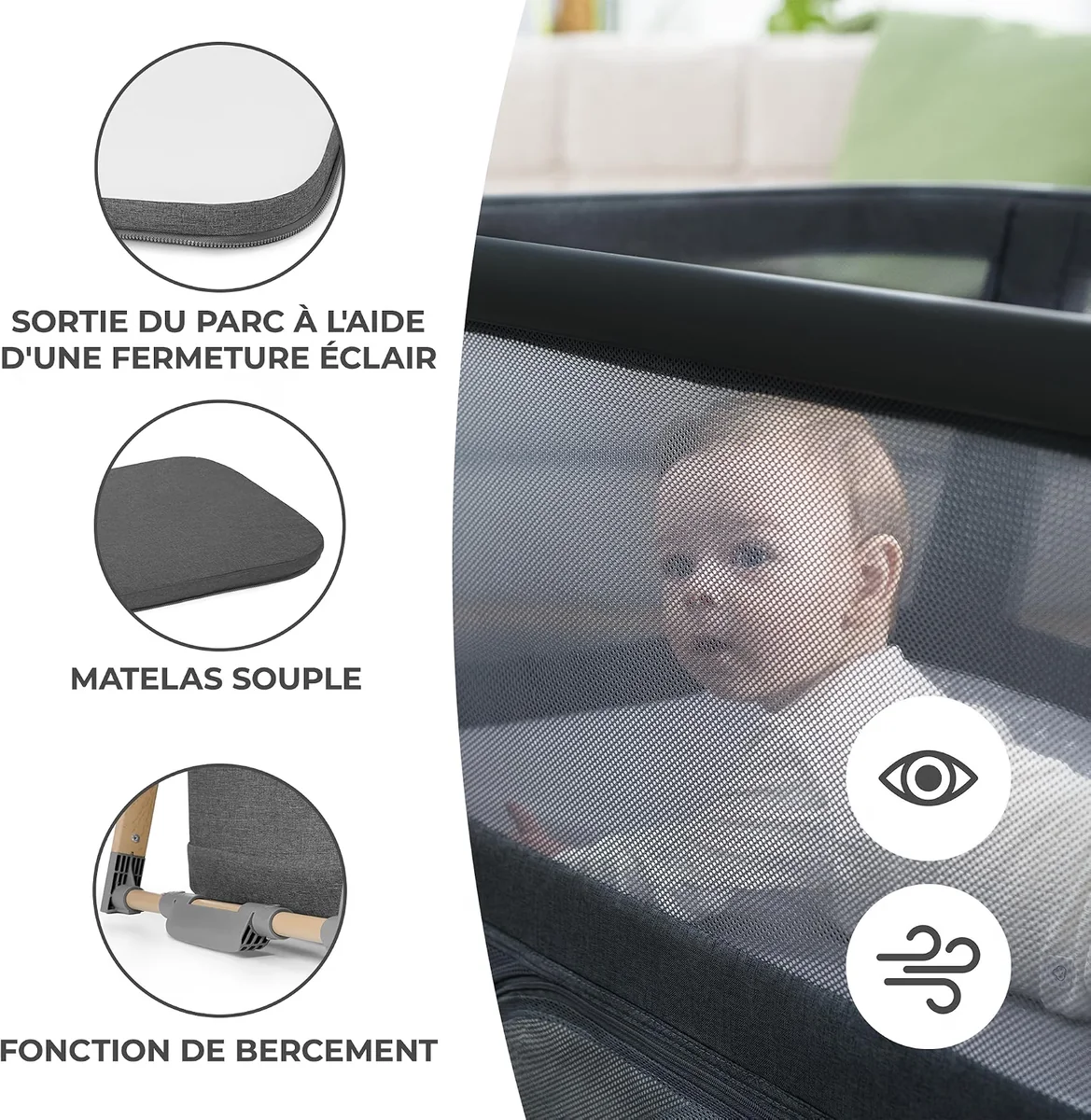
- 4-in-1Cot, travel cot, playpen, crib
- 15 kgMaximum child weight
- 2Mattress heights
- 14 cmFolded thickness
- 30 °CMachine-washable cover
- 0Tools needed
14 cm thick once folded.
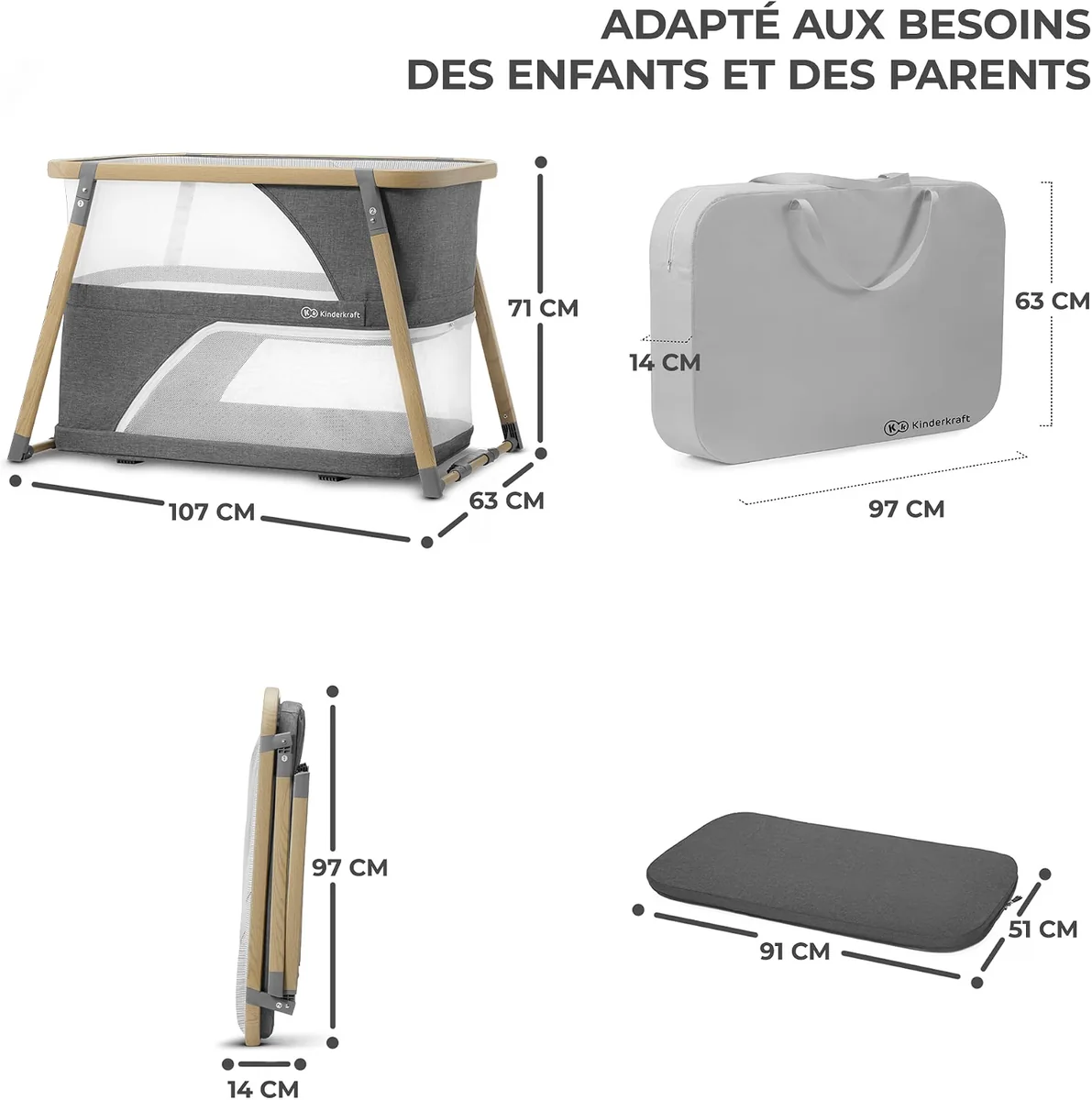
- 107 x 63 x 71Open (cm)
- 97 x 63 x 14Folded (cm)
- 8.7 kgCot weight
- 15 kgMaximum child weight
- ≈ 91 x 52Mattress (cm)
- 2Sleeping heights
Dimensions, weight and 15 kg limit published by Kinderkraft; the mattress size comes from specialist retailers’ listings (91 x 52 cm) and the manufacturer’s visual (91 x 51 cm). Folded, the Sofi is long (97 cm) but very flat. See our guide to travelling with a travel cot.
Guide contents
Comparison: the right folding cot for you
There is no such thing as the perfect travel cot, only families who expect different things from one. Some want a spare cot for two weekends a year. Others want a cot that will be used every night in the parents’ bedroom for the first months, then at the childminder’s or the grandparents’. Others still fly often and count every kilo. Before comparing models, it is worth working out which of these situations is yours.
| Your situation | What you need | The point to watch |
|---|---|---|
| Baby sleeps in your room for the first months | A folding cot with a height-adjustable mattress, suitable from birth | The high mattress position and its weight limit |
| Weekends and holidays by car | A cot that folds quickly, with a carry bag | The folded dimensions compared with your boot |
| A cot that stays at the grandparents’ | A stable cot, easy to understand, with a proper mattress | The instructions left with the cot and sheets in the right size |
| Frequent flying | An ultralight travel cot, around 6 kg or less | Comfort and length of use, often shorter |
| A daytime playpen | A cot with a side opening or a dedicated playpen | The height of the sides and the strength of the base |
The cot we feature, the Kinderkraft Sofi 4-in-1, ticks the first three lines. It is not the lightest choice for flying, and we say so clearly below. If you are still hesitating between product families, our article travel cot, playpen or bassinet sets out the differences.
What is a travel cot?
A travel cot is a bed for babies and young children that folds up on itself for storage or transport. In French it is called a “lit parapluie”, an umbrella cot, because of the original folding mechanism: you pull the centre of the base upwards, the sides come together and the cot closes into a kind of bundle, like an umbrella. It is made of a jointed metal frame, fabric and mesh sides, and a base on which a thin mattress rests. It is also called a folding cot, a portable cot or a spare cot.
That classic model still exists. It now has many cousins: cots that fold flat like a suitcase, very light travel bassinets, 4-in-1 cots that also act as a playpen and a crib. They all answer the same idea: to give the child a safe, familiar place to sleep wherever they are, without carrying a full-size cot around.
A useful bit of background: many parents think a travel cot is only for emergencies. French prevention bodies say much the same thing: a French county council childcare guide describes it as a bed for “occasional use”. Recent models with a raised mattress are nevertheless used more often than before as the main bed for the first months, in the parents’ bedroom. That is not forbidden, as long as you follow the manufacturer’s instructions and the safe sleep rules for babies set out below.
Our pick: the Kinderkraft Sofi 4-in-1
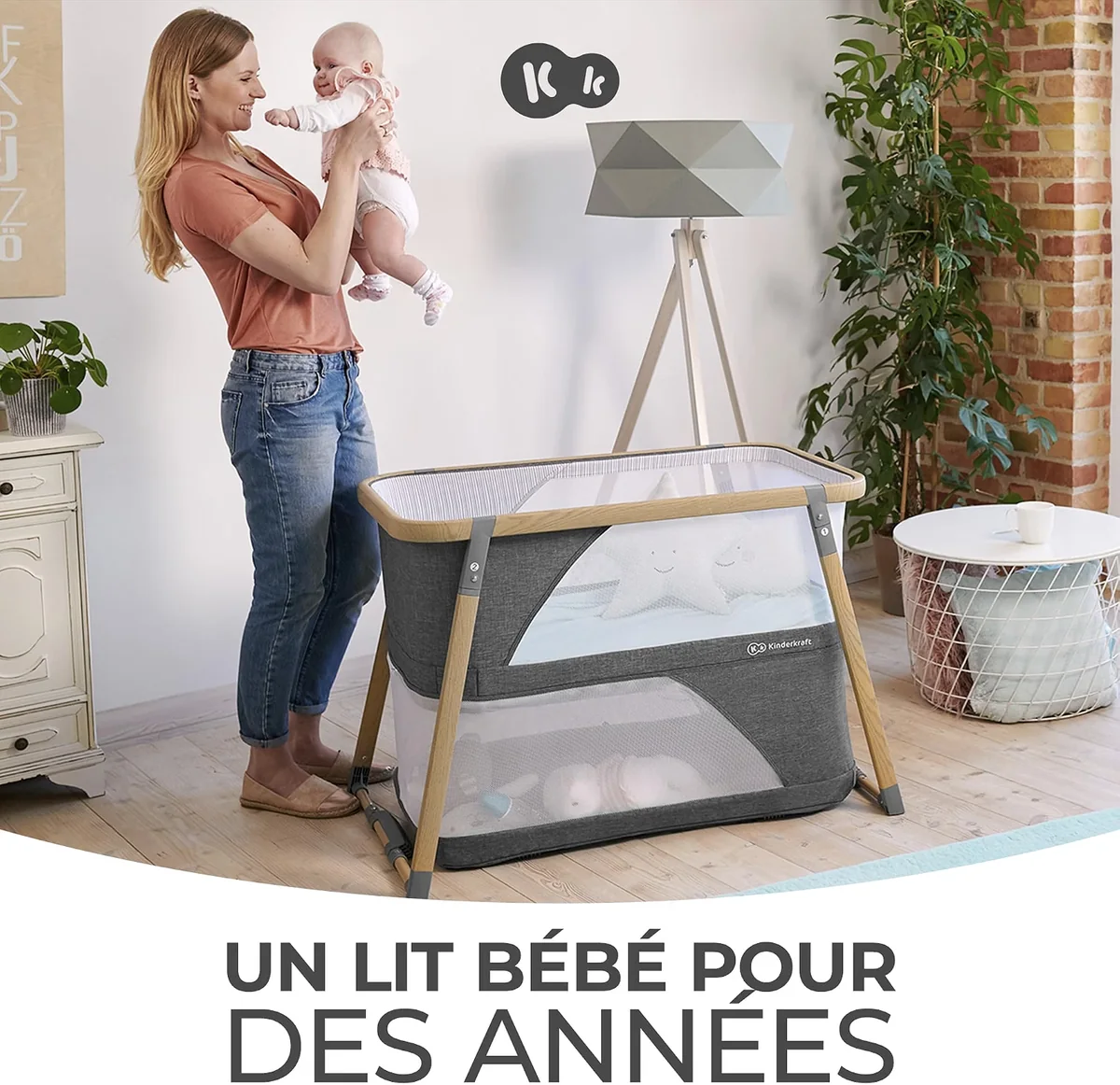
The Kinderkraft Sofi is a folding baby cot designed for four uses: bedroom cot, travel cot, playpen and rocking crib. Kinderkraft rates it from birth up to 15 kg, which retailers equate to about three years. It comes with its mattress, which has two heights, and with a carry bag.
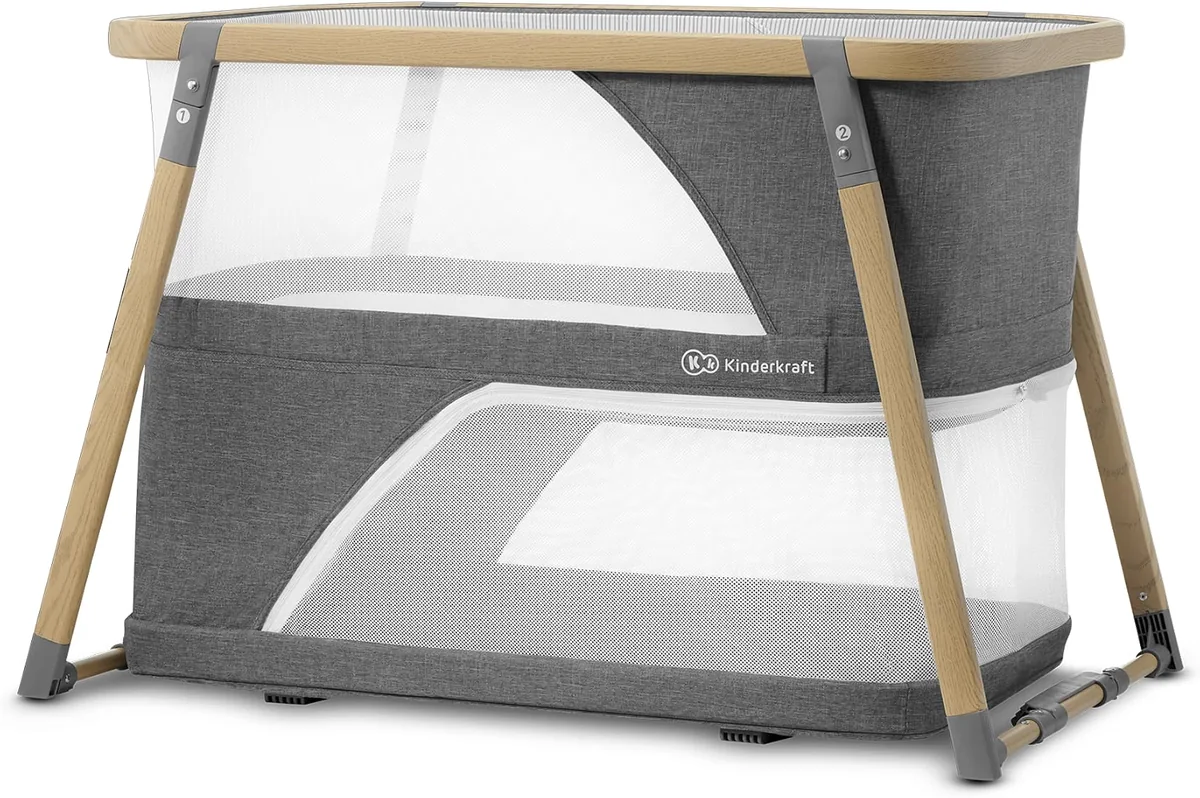
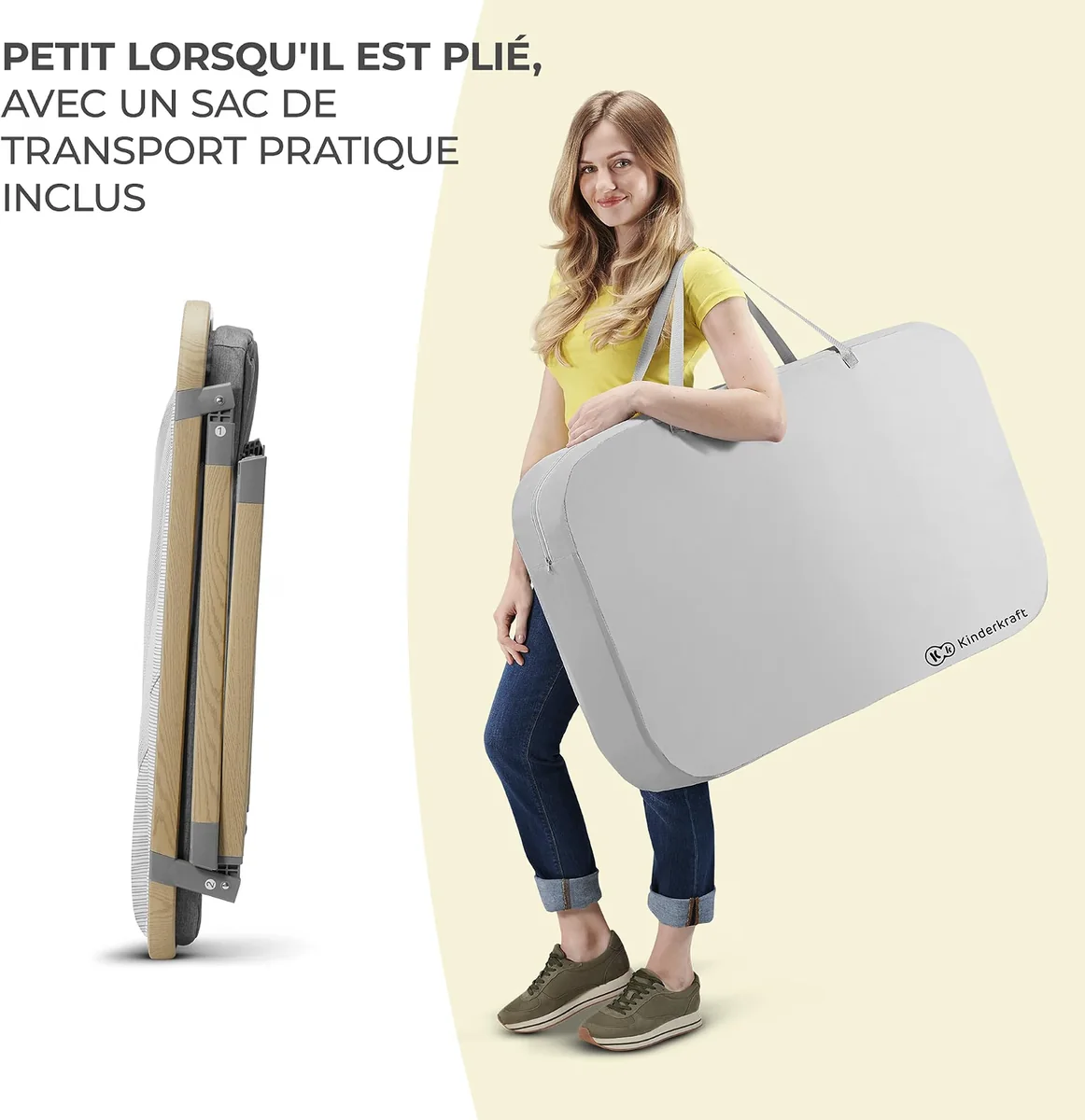
What sets it apart from a classic travel cot is first of all its construction. The Sofi does not fold into a bundle: it folds flat, into a slab 14 cm thick, 97 cm long and 63 cm wide according to the manufacturer. Open, it measures 107 x 63 x 71 cm and weighs 8.7 kg. The frame combines steel legs and an aluminium top rail with a light wood-effect finish, white mesh sides and a grey marl fabric. The manufacturer declares it compliant with EN 716-1:2017 for cots and EN 12227:2010 for playpens.
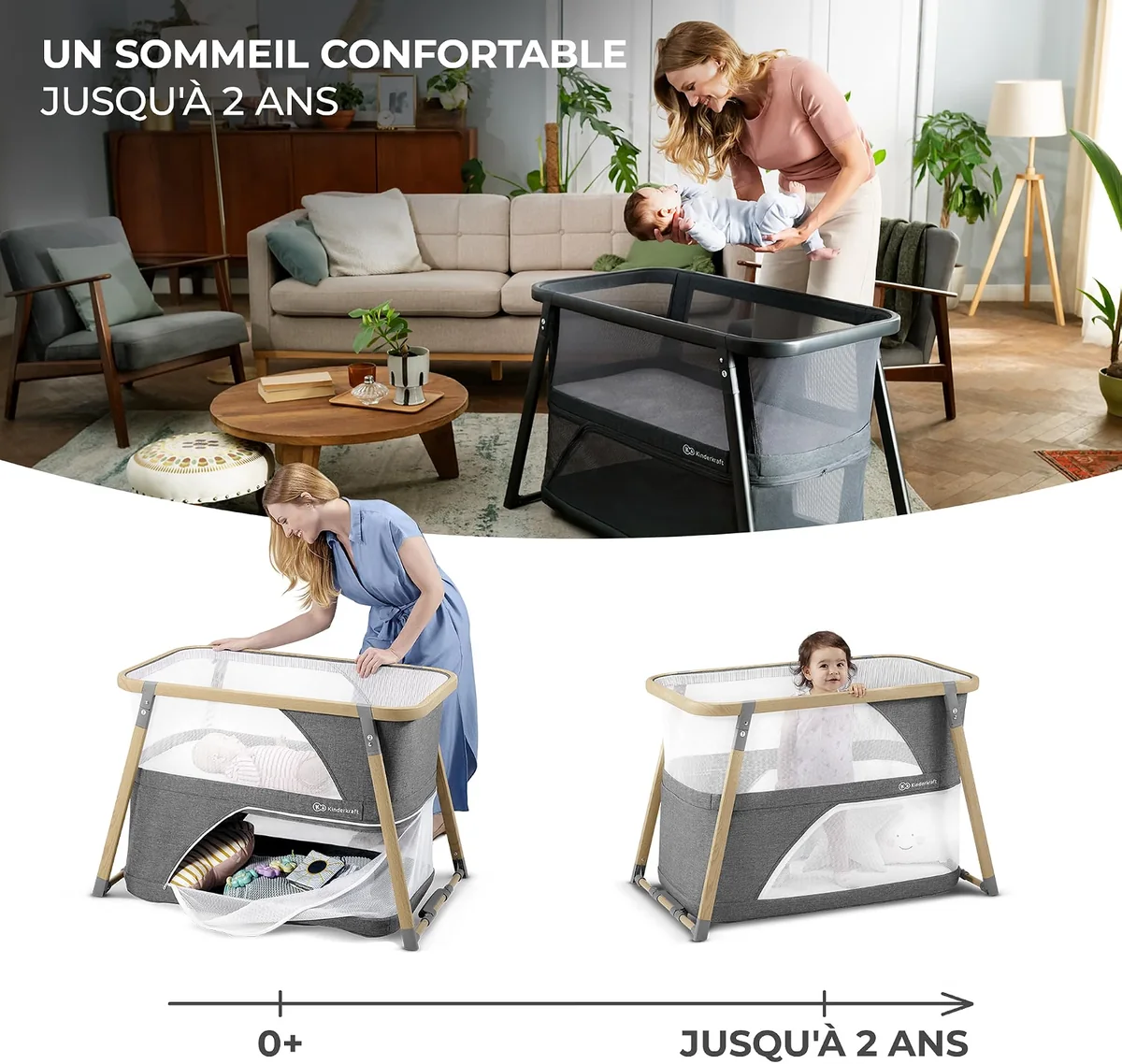
The mattress, with a cover whose top is cotton, sits in the high position for the very youngest, or at the bottom of the cot as the child grows. The cover is removable and machine washable at 30 °C. Feet that can be locked or unlocked turn the cot into a crib that rocks. A zipped opening on one side turns it into a playpen the child can climb in and out of. No tools are needed to switch from one function to another or to fold it.
Its limitations come down to three points, which we detail in the full review: a mattress of about 91 x 52 cm, smaller than the 60 x 120 cm size of most travel cots, which means you need sheets to match; a folded length of 97 cm that can be awkward in a small boot; and a weight of 8.7 kg that makes it less suited to air travel than an ultralight cot.
From birth: under what conditions?
Most travel cots are sold as suitable “from birth”. This means the cot meets the safety requirements to take a newborn, not that every use is equal. Three conditions matter for a very young baby.
- A flat, firm sleeping surface. French recommendations are consistent: baby sleeps on their back, flat, on a firm mattress that fits the cot, covered with a well-fitted sheet. The mattress supplied with the cot is designed for exactly that.
- Nothing else in the cot. No pillow, duvet, bumper, sleep positioner or soft toy. Baby sleeps in a sleeping bag that fits their size.
- No extra mattress. A prevention sheet from the regional union of private doctors in Normandy, France, puts it plainly: in a travel cot, adding a mattress is dangerous. It is the rule most often forgotten, because the original mattress looks thin.
The high mattress position is the other key to the first months. It saves you from bending right down to the floor to lay a sleeping baby down, which is a relief for your back after a birth or a caesarean. For the Sofi, a review published by a British parenting magazine gives a 9 kg limit in the high position, and retailers specify that the mattress must be lowered as soon as the child starts to sit up. The principle is the same on every two-level cot: the high position is for babies who cannot yet pull themselves up. Our article travel cot from birth covers this period in detail.
Travel cot, playpen or bassinet?
Shops tend to mix up these words. Here is how to tell them apart.
| Type | For whom | Strengths | Limitations |
|---|---|---|---|
| Classic travel cot | Occasional use, from birth to about 3 years | Large sleeping area, often 60 x 120 cm, sturdy | Thin mattress on the base, bulky when folded, heavy |
| Flat-folding 4-in-1 cot | Bedroom in the early months, weekends, grandparents | Raised mattress, crib, playpen, flat storage | Sleeping area sometimes smaller, specific sheets |
| Ultralight travel cot | Air travel, hiking, small spaces | Low weight, very compact fold | Sleeping surface often low, high price, variable length of use |
| Playpen | Daytime play | A safe space to play | Not always designed for sleep, check the instructions |
| Crib or Moses basket | The first months only | Sleeping close to the parents, compact | Short period of use, low weight limit |
The Sofi belongs to the second family. It acts as a crib thanks to the high mattress and the rocking feet, as a cot thanks to the low mattress, and as a playpen thanks to its zipped opening. That versatility comes at a cost in bulk and sleeping area, which we explain in our complete guide to choosing a travel cot.
The 10 criteria of a good travel cot
- Age and maximum weight. “Up to 3 years” is not enough: look for the child’s maximum weight. On the Sofi, it is 15 kg.
- The size of the sleeping area. It determines how comfortable a two-year-old will be and which sheets you can use. 60 x 120 cm is the most common size, but it is not universal.
- The mattress supplied. It must be designed for that specific cot, firm, and fit with no gaps along the sides.
- Adjustable height. A high level makes the first months much easier, provided you respect its limit.
- Folding. How many steps, tool-free or not, flat or bundled, and above all: is the locking clear and visible?
- The weight of the cot. Around 6 kg or less for flying, often 8 kg or more for more complete cots.
- Folded dimensions. To compare with your boot, your cupboard or the space under your bed.
- Mesh. It should cover at least the sides where baby’s head lies, for airflow and visibility.
- Cleaning. Removable mattress cover, washable fabric, mesh that is easy to brush.
- Standards. EN 716 for a cot, EN 12227 for a playpen: a serious 4-in-1 cot displays both.
To check the first and seventh criteria quickly with your own figures, our calculator compares your child’s weight and your storage space with the limits announced by Kinderkraft.
The mattress: the most misunderstood point
On parents’ review sites, the same comment comes up for almost every travel cot: “the mattress is too thin”. Many parents conclude that they should add a second, thicker one. That is precisely what prevention guidance advises against. A safety guide published by a French county council says it in so many words: the travel cot must comply with standards, and no extra mattress must be added. Health Canada and the US Consumer Product Safety Commission say the same: use only the mattress supplied with the cot or playpen, with no added padding.
Why so strict? A baby must sleep on a flat, firm surface that does not sink under their face, with no gap between the mattress and the sides of the cot. A second mattress, often softer and not exactly the right size, creates both risks at once. The French public health website sante.fr insists on a firm mattress that fits the dimensions of the cot perfectly to avoid any risk of suffocation.
The Sofi’s mattress partly escapes the criticism: several parents find it comfortable and point out that it does not sag. Its particularity lies elsewhere. At about 91 x 52 cm, it is smaller than a standard travel cot mattress. The 60 x 120 cm fitted sheets sold everywhere therefore do not fit: you need sheets in its size. We explain how to choose them in our article travel cot mattress and sheets.
Remember: if a mattress seems too thin for an older child, the answer is never to stack a second one on top. Check with the manufacturer whether it offers a replacement mattress designed for your model, and follow its instructions.
Two mattress heights: what they are for
A classic travel cot puts the mattress at the bottom, almost at floor level. To lay a newborn down, you have to bend very low, arms outstretched, with a sleeping baby. It is uncomfortable for everyone and it is often the moment baby wakes up. The high position brings the sleeping surface up to hip height.
On the Sofi, the mattress hooks onto the top of the cot for the first months, then is unhooked and laid at the bottom when the child starts to pull up. The manufacturer explains that when the mattress is in the high position, the free space underneath can be used for storage. The rubber pads fitted at the low level insulate the base from the floor and protect wooden floors.
Moving to the low position is not a question of a precise age, but of motor skills. As soon as baby rolls over, pushes up on their arms, sits or gets onto their knees, they could tip over an edge that has become too low for them. It is time to lower the mattress, without waiting for the weight limit. That is the rule our calculator applies when it suggests a mattress level.
Folding, weight and size
A travel cot spends most of its life folded: in a cupboard, at the back of a boot, in a bag. Its folded dimensions therefore matter as much as its open ones. Two families compete.
Bundle fold
- Often a short folded format (around 75 to 80 cm)
- Stands upright in a corner
- A well-known mechanism
Flat fold
- Very slim (14 cm on the Sofi)
- Slides under a bed or against the side of a boot
- Longer: 97 cm on the Sofi
Kinderkraft announces a flat fold in a few seconds without tools. Folded, the Sofi goes into its carry bag, whose dimensions are given on the manufacturer’s visual: 97 x 63 x 14 cm. At 8.7 kg, it can be carried on the shoulder for a few dozen metres, from a car park to a holiday rental, but it is not a cot to carry on a long walk.
The review published by a British parenting magazine describes an instant unfolding: you spread the legs and the cot is up. The testers found it simple enough for grandparents who had been baffled by a classic travel cot. That is a strong argument for a cot that will often change hands.
Mesh, zipped opening and airflow
The mesh is there first of all so you can see baby without waking them: a glance from the door is enough. It also lets air circulate, which matters in summer or in an overheated hotel room. On the Sofi, white mesh covers a large part of the sides, with grey fabric panels at the corners. The Sofi Plus, sold separately, extends the mesh to the head and foot ends: do not confuse the two models when ordering.
The zipped opening turns the cot into a playpen. When it is open, the child can get in and out on their own: it is a play feature, not a sleep feature. For sleep, the zip must stay closed. Several parents report that this zip makes the fitted sheet a little fiddlier to put on in the high position: practise once, in daylight, before the first night.
The rocking function
The Sofi’s legs rest on curved feet. Locked, they keep the cot still. Unlocked, they let it rock gently, like a crib. According to one retailer, two plastic wedges on the sides provide this crib mode.
Rocking is a tool for getting baby to sleep, not a night-time mode. Once baby is asleep, lock the feet again, especially when the child starts to move or pull on the sides. A cot that rocks under the weight of a child pulling themselves up is no longer a crib at all. Our how-to guide goes through this step by step.
Putting baby to sleep safely
A good cot does not do everything. Safe sleep rules for babies apply to a travel cot just as they do to a full-size cot. Here they are, as published by French health authorities and prevention networks, which are in line with those of other European and North American health bodies.
- On their back, flat, for every nap and all night, from birth.
- Never on their tummy or side, and with no cushion or rolled towel to hold them in place.
- A firm mattress that fits the cot, with a well-fitted sheet. No second mattress.
- Nothing in the cot: no pillow, duvet, blanket, bumper or soft toy.
- A sleeping bag that fits their size, and a room that is neither too hot nor smoky.
- In the parents’ room for the first months, but in their own cot.
The French public health website sante.fr also points out that sleep nests and hammocks are banned before 6 months in France, and that baby should not sleep on a sheepskin or fleece laid on the sheet. These rules aim to prevent sudden unexpected infant death. Our article travel cot safety covers them in detail, with the checks to make before every night.
If you would like to talk it through with a professional, your GP, midwife or health visitor is the right person to ask.
On holiday and at the grandparents’
The travel cot really comes into its own away from home. Babies sleep better when they find a familiar place: their cot, their sleeping bag, their bedtime routine. A cot that travels with them carries some of those landmarks along. A few tips to make it work:
- Set the cot up at least once at home before you leave, to check all the parts are there and to get used to the mechanism.
- Pack sheets in the right size, the sleeping bag and, if baby is used to it, the night light: these are the items most often forgotten.
- Choose the spot carefully: away from windows, curtain and blind cords, radiators and anything the child could grab.
- At the grandparents’, leave the instructions with the cot and show them the folding and locking once.
On a plane, the Sofi is less at ease: its 97 cm length and 8.7 kg mean it goes in the hold. Baby equipment hire companies and many hotels offer cots on site, to check when you book. Our articles travelling with a travel cot and the travel cot at the grandparents’ go further.
Cleaning and storage
A well-kept travel cot will see several children through. The essentials come down to a few habits:
- The mattress cover comes off and is machine washable at 30 °C according to Kinderkraft. Let it dry completely flat before putting it back.
- The mesh can be dusted with a vacuum cleaner and a soft brush, and spot-cleaned with a damp cloth and mild soap.
- The frame can be wiped with a damp cloth. Each time you set it up, check that the joints lock properly and that no screw is loose.
- Storage should be dry, in the bag, after complete drying: a cover put away damp soon smells musty.
The French consumer safety authority (DGCCRF) recommends never modifying a childcare product and not repairing a worn or damaged part yourself: go through the manufacturer’s after-sales service. Our article travel cot cleaning and care details each step.
Standards and labels to check
Two European standards cover these products. EN 716 covers cots and folding cots for domestic use: it has a safety requirements part (EN 716-1) and a test methods part (EN 716-2). EN 12227 covers playpens for domestic use. A cot that is also a playpen, like the Sofi, does well to display both. Kinderkraft states EN 716-1:2017 and EN 12227:2010 for this model.
In France, childcare products must also carry the statement “Conforme aux exigences de sécurité” (complies with safety requirements), the name or brand of the manufacturer or importer, and usage warnings. Wherever you live, check for the standard number, the manufacturer’s identification and instructions in your language, and keep them with the cot.
Mistakes to avoid
- Adding a second mattress, a mattress topper or a folded duvet at the bottom of the cot.
- Leaving the mattress in the high position when baby starts to pull up.
- Using a fitted sheet that is too big and creases, or a tucked-in flat sheet.
- Putting baby to sleep with the playpen zip open.
- Leaving the rocking feet unlocked all night.
- Placing the cot near a window, a radiator or curtain cords.
- Continuing to use the cot above 15 kg, or once the child starts climbing it.
- Setting up the cot for the first time at midnight, in an unfamiliar room.
Who it is for, and who it is not for
The Sofi is for you if
- You want a cot for the bedroom in the early months, then for weekends
- You want a raised mattress to lay baby down without hurting your back
- You mostly travel by car
- You want a cot that stays set up at the grandparents’
- You store the cot under another bed or behind a door
Look elsewhere if
- You mostly travel by plane with limited luggage
- Your boot is less than a metre long inside
- You want to use your existing 60 x 120 cm sheets
- Your child is already close to 15 kg
- You want a child’s bed for several years of nightly use
Buying on Amazon: what to check
The Sofi comes in several versions and colours, and the Sofi Plus is sold alongside with two fitted sheets and more mesh. Before ordering, check the exact model name, the colour, the seller and what is included: mattress, bag, any sheets. The Amazon link on our site points to the current offer; the price changes, so we do not display it.
Keep your rights in mind: when you buy online from a UK seller, you have 14 days to cancel and the protection of the Consumer Rights Act if the product is faulty. The manufacturer also mentions an optional warranty extension of up to 10 years, subject to its own conditions: read them before activating it.
Check the price on AmazonKinderkraft Sofi cot · new tabOur editorial method
We are not a test laboratory. The dimensions, weights and limits quoted on this site are those published by Kinderkraft or by specialist retailers, and we name the source each time. Parents’ feedback is summarised as trends, with no quotes or names. The safety rules come from health and prevention authorities. Everything is explained on our affiliate disclosure and method page.
Frequently asked questions
What is the best travel cot?
The one that suits your use. For a cot that serves in the bedroom in the early months and then on weekends away, we recommend the Kinderkraft Sofi 4-in-1, with a two-height mattress and a flat fold. For flying, a lighter travel cot is a better fit.
Is a travel cot suitable from birth?
Yes, if the manufacturer says so and you follow the safe sleep rules: baby on their back, the mattress supplied, a fitted sheet, nothing else in the cot.
Can you add a mattress to a travel cot?
No. French prevention guidance considers it dangerous to add a mattress to a travel cot. Use only the mattress designed for your cot.
Up to what age can a travel cot be used?
Up to the manufacturer’s weight limit, 15 kg for the Sofi (about 3 years), or earlier if the child starts climbing out.
What sheet size for the Kinderkraft Sofi?
Its mattress measures about 91 x 52 cm according to retailers. The 60 x 120 cm sheets of classic travel cots are too big: choose fitted sheets in its size.
Can a travel cot be used as an everyday bed?
A compliant cot can be used every night in the early months if the manufacturer allows it. For several years of nightly use, a regular cot or child’s bed offers more space.
How much does the Kinderkraft Sofi weigh?
8.7 kg according to Kinderkraft. Folded, it measures 97 x 63 x 14 cm and fits into its carry bag.
Can the Sofi go as cabin baggage?
No. At 97 cm long folded, it exceeds the usual cabin sizes: on a plane, it travels in the hold.
Is the Sofi a bedside crib?
No. It is not designed to attach to the parents’ bed. It stands next to it, at a short distance, as a separate cot.
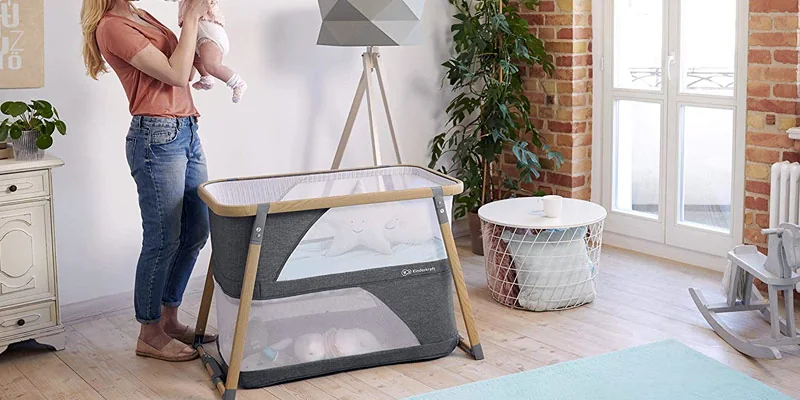
At home, at Grandma’s, on holiday.
The same little nest, wherever you sleep: the moments when a 4-in-1 travel cot really makes sense.
Technical specifications.
- UsesCot, travel cot, playpen, rocking crib
- Suitable forFrom birth to 15 kg (about 3 years)
- Cot weight8.7 kg
- Open107 x 63 x 71 cm
- Folded97 x 63 x 14 cm
- MattressIncluded, about 91 x 52 cm, 2 heights
- FrameSteel legs, aluminium top rail
- CoverCotton top, machine washable at 30 °C
- StandardsEN 716-1:2017, EN 12227:2010
Kinderkraft data (Sofi product page) and retailers’ listings for the mattress size. Details and sources in our full specifications.
Kinderkraft Sofi 4-in-1 travel cot
- Versatility★★★★★
- Folding and carrying★★★★★
- Sleeping comfort★★★★★
- Folded size★★★★★
- Finish★★★★★
- Value for money★★★★★
The Kinderkraft Sofi is aimed at parents who want a single folding cot for the bedroom in the early months, weekends away and the grandparents’ house.
It is not for everyone: its compact mattress and 97 cm folded length make it a spare and bedroom cot more than a cot for flying. Our detailed verdict explains who it is for, and who it is not for.
Why it is our top pick
- One cot for four uses: bedroom cot, spare cot, playpen and rocking crib, from birth to 15 kg.
- A mattress included with two heights: in the high position, you can lay a newborn down without bending double.
- Folds flat, without tools, into a 14 cm slab that stores under a bed or in the bag supplied.
- Mesh sides that let you see baby and let air through, with a zipped opening for playpen mode.
- A removable cover with a cotton top, machine washable at 30 °C.
- A grey and light-wood look that does not feel like camping gear in a bedroom.
Limitations
- The mattress (about 91 x 52 cm) is smaller than the 60 x 120 cm size of classic travel cots: you need fitted sheets in its size.
- Folded, it is flat but long (97 cm): measure the length of your boot.
- At 8.7 kg, it is heavier than ultralight travel cots designed for flying.
- Several parents find the fitted sheet fiddly in the high position, because of the zip.
Our guides to go further.
Choosing, safe sleep, travel, care: our in-depth articles.
Is the Sofi right for your child?
A quick check against the limit announced by Kinderkraft: from birth to 15 kg.
Cot, travel cot, playpen and crib, from birth to 15 kg, with mattress included and travel bag: one cot for home and weekends away.
- 0-15 kg
- 4-in-1
- 14 cm folded
Ready for the first nights?
4-in-1 · From birth to 15 kg · Mattress included · Travel bag. Prices and colours change often on Amazon: check them, along with the seller and the exact model (Sofi or Sofi Plus), before ordering.
Check the price on AmazonAffiliate link · new tab