Helping baby sleep in a travel cot: the complete guide
A well set-up travel cot is only half the job. Babies sleep well when they find their familiar cues: a safe sleeping space, familiar gestures, a calm room. Here is how to bring all of that together, at home and away.
Contents
A word before we start: every baby has their own rhythm, and the advice below is general. If you have any doubts about your child’s sleep, talk to your GP, your midwife or your health visitor.
The foundation: a safe sleeping space
Before talking about routines and atmosphere, there is one non-negotiable foundation: safe sleep. In a travel cot as in a standard cot, the guidance on preventing sudden infant death is the same.
- Baby sleeps on their back, flat, at night and for every nap.
- The mattress is the cot’s own, firm, with a well-fitted sheet.
- Never add a mattress: a prevention sheet from doctors in Normandy, France, describes this as dangerous in a travel cot.
- Nothing else in the cot: no pillow, duvet, blanket, bumper or soft toy.
- Baby wears a sleeping bag that fits their size.
Everything that follows is built on this foundation. A perfect routine never makes up for a cluttered cot. Our article on travel cot safety covers the checks on the cot itself.
Why familiar cues matter
A baby cannot tell the time. What tells them that sleep is coming is a series of clues: the light dimming, the bath, the sleeping bag going on, the same song, the same cot. When those clues repeat, falling asleep gets easier, because baby expects it.
That is the whole point of a travel cot that follows the family. At the grandparents’, in a holiday rental, in a hotel, baby finds the same sleeping space, the same mesh, the same smell of the sheet. The place changes, the nest stays. Parents who use the same cot at home and away often say so: the first night somewhere else goes better.
For this to work, the travel cot has to be part of the routine before you leave. If baby sleeps every night in a full-size cot and meets the travel cot on the first evening of the holiday, the effect is weaker. A few naps at home in the folding cot in the weeks before are often enough to make it familiar.
Building a routine that travels
A bedtime routine does not need to be long. It needs to be repeatable anywhere. Avoid steps that depend on your home (a particular bath, a specific light) and favour ones that travel:
- A quiet moment: screens off, voices lower, noisy toys put away.
- A wash or a bath, depending on your habits.
- Pyjamas and sleeping bag, always in the same order.
- A feed, if that is how you do things.
- A song, a nursery rhyme or a set phrase, always the same.
- Into the cot, on their back, awake or drowsy, with the same goodnight words.
The whole thing takes about twenty minutes. It travels effortlessly, and it tells baby, wherever they are: it is time to sleep.
Choosing where the cot goes
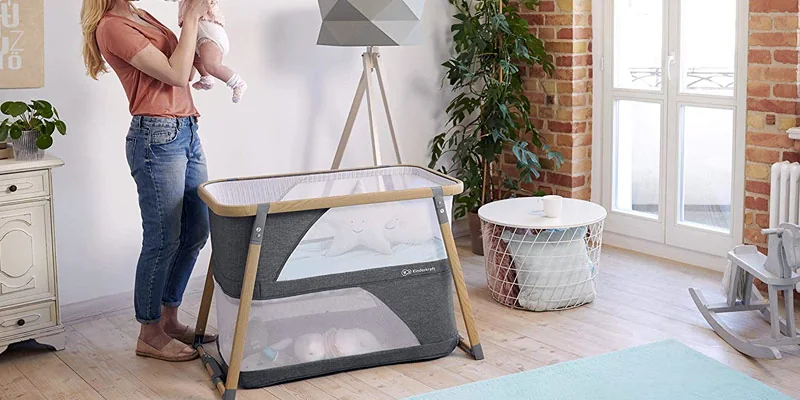
A travel cot is easy to move: make the most of it to find the best spot, not the one that is left. Safety rules first:
- away from windows, and never under a window the child could reach as they grow;
- away from radiators, heaters and other heat sources;
- no cords nearby: blinds, curtains, lamp, baby monitor or night light cables, as Health Canada points out;
- at a distance from furniture, shelves and objects the child could grab through or over the mesh;
- on a flat floor, cot properly locked, rocking feet locked.
Then comfort: a corner of the room rather than the middle, out of the way of people walking past, out of the beam of light from a door opening. If you share the room, place the cot so you can see baby from your bed without getting up.
Light and darkness
Light is one of the strongest sleep signals. In the evening, dim the lights gradually during the routine. At night, a dark room helps baby stay asleep. For naps, low light is enough.
Away from home, the room is rarely as dark as at home. Rather than covering the cot with a sheet for shade, which would reduce air flow and could fall onto baby, block the window: draw the curtains, lower the blind, or fix a portable blackout blind to the glass. A small night light, if baby is used to one, is plugged in away from the cot, cable out of reach.
Noise and quiet
A baby does not need total silence. Many fall asleep very well with the normal sounds of a home. The problem is mostly sudden noises: a door slamming, a conversation getting louder, a phone. Away from home, it is also unfamiliar noises: a busy street, a creaking floor, a large family in the next room.
A few simple tricks: place the cot away from the door and the noisiest shared wall, let your hosts know baby’s bedtime, keep a steady background sound if baby is used to one. Consistency is what matters: a stable sound environment reassures more than a perfect silence that does not last.
Temperature and clothing
A baby who is too hot sleeps badly, and an overheated room is not recommended. Dress baby according to the room temperature: a bodysuit, pyjamas, a sleeping bag with a tog rating suited to the season. No hat for sleeping indoors, no blanket.
To tell whether baby is too hot or too cold, feel the back of their neck or their back rather than their hands, which are often cool. A clammy neck means they are too hot. The mesh of a travel cot lets air circulate well, which helps in summer. In winter, avoid placing the cot in a draught or against a cold wall.
Never cover the cot with a sheet, blanket or towel to create shade or keep warmth in. The mesh must stay clear.
Naps in the travel cot
Naps are often the weak link of days away: they get moved, they happen in the car, in the pushchair, in someone’s arms. Sometimes that cannot be helped. When you can, offer at least one nap a day in the travel cot, at a roughly fixed time. That way the cot stays linked to sleep.
At home, the travel cot can become the nap cot, set up in the living room or your bedroom, while the full-size cot stays the night cot. It is a good way to make it familiar before the holidays. The rules are the same as at night: on the back, nothing in the cot, playpen zip closed, feet locked.
A car seat, a pushchair or a bouncer is not a bed: if baby falls asleep in one, move them to a flat sleeping surface as soon as you can. The French public health website sante.fr advises not leaving a child too long in a car seat, to encourage free movement.
Sharing the room
Guidance recommends that baby sleeps in the parents’ room for the first months, but in their own cot. A travel cot lends itself very well to this. Health Canada recommends placing the child’s cot in the parents’ room for the first six months.
Sharing the room also means learning to live together. A few tips:
- go to bed without switching on the main light: a torch pointed at the floor is enough;
- do not rush in at the slightest sound: many babies stir, grunt or cry briefly in their sleep;
- keep a low-key night routine: little light, few words, back to bed quickly;
- if you snore or your partner gets up early, move the cot a little or adjust which way it faces.
When baby shares a room with a brother or sister, on holiday for instance, explain the travel cot rules to the older child: nothing goes in it, no leaning over it, no opening the zip.
Sleeping away from home
At the grandparents’, at friends’, in a rental, in a hotel: every place has its pitfalls. A few common principles:
- Set the cot up as soon as you arrive, before dinner, while everyone still has energy and daylight.
- Make the cot with your own sheets: the familiar smell matters.
- Recreate the room: same position of the cot relative to your bed, same night light if you have one.
- Keep to the usual times as far as possible, at least for evening bedtime.
- Tell your hosts about bedtime and the cot’s safety rules.
Our articles travelling with a travel cot and the travel cot at the grandparents’ cover these situations in detail.

The first night in a new place
The first night somewhere else is often the hardest, even with a familiar cot. Baby senses that something has changed. A few things help:
- Let baby explore the room in daylight: play in the room for a while, put baby in the cot awake for a few minutes.
- Keep the routine exactly the same, without shortening it because everyone is tired.
- Stay a little longer at bedtime if baby needs it, then go back to your usual habits on the following nights.
- Accept a less good night: the second is often much better.
Night waking and crying
Night waking is part of a baby’s sleep, especially in the first months. A travel cot neither stops it nor causes it. When baby wakes at night:
- check the simple needs first: hunger, nappy, too hot or too cold;
- keep a night-time atmosphere: low light, quiet voice, calm movements;
- put baby back down on their back, in their sleeping bag, without adding anything to the cot;
- if you use the cot’s rocking function to settle them again, lock the feet afterwards.
If the crying worries you, if it is unusual, or if baby has a fever, is breathing badly or refuses feeds, contact a health professional straight away, call NHS 111, or dial 999 in an emergency.
What changes with age
The set-up changes over the months:
| Stage | Mattress | Points to watch |
|---|---|---|
| First weeks | High position if the cot allows | On the back, sleeping bag, shared room |
| First rolls | Move to the low position | Stop using the rocking at night |
| Baby sits up, stands | Low position | Nothing near the cot that could be used as a step |
| Baby walks, climbs | Low position | Watch for climbing attempts |
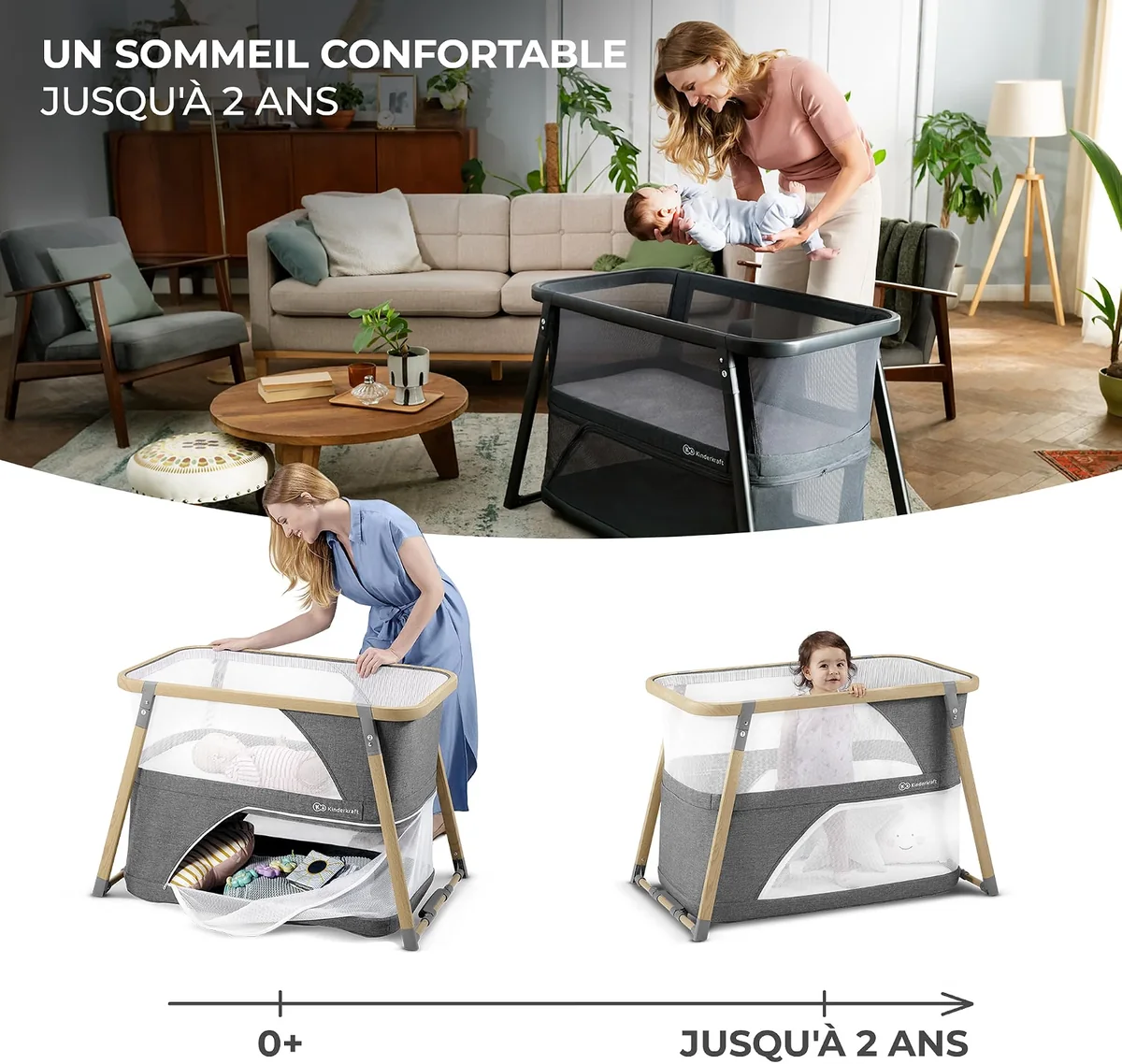
| Nearing 15 kg or climbing out | Stop using it | Move to a child’s bed |
For the Kinderkraft Sofi, a published test gives a limit of 9 kg for the high position, and Kinderkraft sets the cot’s limit at 15 kg. Our calculator suggests the right level.
From travel cot to child’s bed
A travel cot has an end. When the child is nearing the weight limit, or starts climbing out, it is time to move to a child’s bed. A few tips for a smooth transition:
- keep exactly the same bedtime routine;
- carry the cues over: the same sleeping bag while it still fits, the same night light;
- choose a calm moment, not the week of starting nursery or the arrival of a sibling;
- the travel cot can remain the holiday bed for a while, as long as the child is under the weight limit and is not climbing.
At the childminder’s or nursery
Many babies nap in a travel cot at their childminder’s. Early years professionals are trained in safe sleep, and in France the local maternal and child health services (PMI) publish guides for them. One of these, published by a French département, points out for example that the travel cot must comply with standards, that no extra mattress should be added, and that cot bumpers are not allowed.
So that naps go well from one place to another, talk to the childminder about a few things:
- your child’s usual nap times and tiredness cues;
- the settling routine you use at home;
- the sleeping bag: provide one in the right size that stays there;
- the night light or music if your child is used to it, when that fits with how the setting is run.
The other way round, if your child settles very well at the childminder’s, ask how they do it: there are often good ideas to borrow at home.
Siblings, twins and cousins
On holiday, several children sometimes share a room: an older child and a baby, twins, cousins. A few rules apply:
- One child per cot. Two babies do not sleep in the same travel cot, even small ones, even twins.
- Cots kept apart, so that one child cannot grab what is in the next cot, or use one cot to climb into the other.
- Rules explained to the older child: nothing is thrown into the baby’s cot, no leaning over it, no opening the zip.
- Staggered bedtimes if needed: the youngest first, in a calm room, then the older child, quietly.
If an older child also sleeps in a travel cot, check that they are still under its weight limit and are not trying to climb out. Beyond that, a spare bed suited to their age is safer.
Jet lag and clock changes
A trip to another time zone, or the clocks going forward or back, upsets baby’s cues. The familiar travel cot helps, but it is not enough on its own. A few principles:
- Shift bedtime gradually by a few minutes a day before you leave, when you can.
- Follow daylight when you arrive: outings in the morning, soft light in the evening.
- Keep the bedtime routine exactly the same, even if the time changes.
- Accept a few restless nights: most babies adapt within a few days.
During this period the safety rules stay the same: even if baby wakes in the middle of the night, they go back down on their back, in their empty cot, with the rocking feet locked.
And the parents’ sleep?
We talk a lot about babies’ sleep, less about parents’. In the first months nights are broken, and tiredness weighs on mood, patience and alertness. A travel cot can help you sleep better too, in very practical ways:
- The raised level saves you getting fully up to check on baby, and makes night-time care easier.
- The mesh lets you glance over from your bed without switching on the light.
- The cot in your room cuts down trips along the landing, without sharing your bed.
If tiredness becomes overwhelming, if you feel you cannot cope, or if you fall asleep holding baby, talk to your GP, your midwife or your health visitor. A break from someone close, even for one night, often makes a big difference. And never settle down with baby on a sofa or armchair when you are exhausted: the risk of falling asleep together there is real, and it is not a safe sleeping place for a baby.
Recognising tiredness cues
An overtired baby often finds it harder to fall asleep than a baby put down at the right moment. Learning to spot tiredness cues helps you put baby down in the right window, especially away from home, when usual times are disrupted. The most common signs:
- yawning, rubbing eyes or ears;
- a fixed stare, turning away from toys and faces;
- grizzling, fidgeting or crying for no obvious reason;
- jerky movements, arching the back.
Every baby has their own signals. Watch yours for a few days at home, and note when in the day they appear. On holiday, these signals replace the clock: as soon as they appear, start the routine and head for the travel cot, even if the usual time has not come yet.
Helping baby settle without creating dependence
Rocking, singing, staying by the cot: these gestures soothe baby and are part of your relationship. The rocking function of a cot like the Sofi can also help. The idea is not to stop them, but to avoid baby being unable to fall asleep without them, in the middle of the night as well as at bedtime.
- Put baby down drowsy but still awake, when possible, so they know the moment of falling asleep in their cot.
- Reduce the help gradually: rock for less time, sit beside the cot, then near the door.
- Keep a set goodnight phrase, always the same: it becomes a signal.
- Stop the rocking before baby is deeply asleep, and lock the feet again.
There is no single right method, and every family finds its own balance. If settling problems persist, talk to your GP or health visitor, who can support you without judgement.
When baby is unwell
A cold, teething or a fever disrupts sleep, at home as on holiday. The temptation to change the sleeping set-up is strong: raising the head with a pillow, adding a blanket, taking baby into your bed. The rules stay the same when they are unwell. No cushion or pillow to raise the head, unless explicitly advised by a doctor and with a device designed for it. No blanket: a suitable sleeping bag, and a room neither too hot nor too cold. No sleeping in the parents’ bed: move the travel cot closer to your bed instead, to keep an eye on them.
Watch their temperature, hydration and breathing. If baby has a fever under 3 months, has difficulty breathing, refuses feeds, is unusually drowsy, or if you are worried, seek medical advice straight away or call 999 in an emergency. Away from home, find out on arrival where the nearest out-of-hours doctor or pharmacy is: a simple precaution that avoids stress in the middle of the night.
Once the illness has passed, go back to your habits quickly: same routine, same cot, same times. Restless nights sometimes leave new habits behind, such as needing to be rocked for longer, which are best not allowed to settle in.
Very early mornings
Some babies wake at dawn, especially in summer or in a room that lets light in. Before thinking it is a sleep problem, look at the room: light coming round the curtains is the most common cause away from home. A portable blackout blind or a few clips to close the gap between curtains often gain half an hour. Do not rush in at the first sound: a baby who babbles quietly may go back to sleep. If they are clearly awake, start the day calmly, with natural light and a little routine of its own, so that waking up in the travel cot is not confused with the middle of the night. Keeping a regular bedtime, rather than putting baby down later in the hope that they will sleep in, usually works better.
Coming back home
After a holiday or a stay with the grandparents, it sometimes takes a few nights to get back to the usual rhythm. Go back to your home times and routine from the first evening, without trying to make up lost sleep with very long naps. If baby usually sleeps in another cot, they will soon find their bearings again. If they also sleep in the travel cot at home, unpack it first, make it with clean sheets, and set it back in its usual place before bedtime.
Mistakes to avoid
- Adding a mattress, cushion or duvet to make the cot “cosier”.
- Covering the cot with a sheet for shade.
- Setting the cot up under a window or near a radiator.
- Leaving toys, soft toys or a large comforter in a young baby’s cot.
- Leaving the zipped opening open during a nap.
- Working out how to assemble the cot on the evening you arrive, by torchlight.
- Keeping the mattress in the high position once baby starts to sit up.
- Putting baby in the parents’ bed because the travel cot has not been set up.
With the Kinderkraft Sofi
The Sofi has several strengths for this way of life: a raised level for the first months in the parents’ room, rocking to help baby settle, mesh that lets you see baby, a flat fold and a bag so that it follows the family. Remember to get sheets in the size of its mattress, about 91 x 52 cm, for home and for trips. Our user guide goes through the steps one by one.
Frequently asked questions
Why does baby sleep badly in the travel cot?
Often because the place is new or the cot is not yet familiar. Offer naps in the travel cot at home before you leave, and keep the routine exactly the same.
Can I put a comforter in the travel cot?
Guidance says to put nothing in a young baby’s cot. Ask your GP or health visitor from when a small comforter can be introduced.
Can the travel cot stay in our bedroom?
Yes, it is even recommended for the first months: baby sleeps in the parents’ room, in their own cot.
Do we need a night light?
Not necessarily. If baby is used to one, take it with you and plug it in away from the cot, cable out of reach.
How can I stop baby getting too hot?
A sleeping bag suited to the season, no hat or blanket, cot away from radiators. Check the back of their neck: if it is clammy, they are too hot.
Do pushchair naps count?
They help in a pinch, but a flat sleeping surface is better. Move baby to their cot as soon as you can.
The articles in this section
Ready for the first nights?
4-in-1 · From birth to 15 kg · Mattress included · Travel bag. Prices and colours change often on Amazon: check them, along with the seller and the exact model (Sofi or Sofi Plus), before ordering.
Check the price on AmazonAffiliate link · new tab