Travel cot safety: the complete guide
A compliant travel cot is a safe place to sleep, as long as it is properly assembled, properly placed and properly used. Here are all the rules, from safe sleep advice for babies to checks on the cot itself.
Contents
Our sources: this article draws on recommendations published by the French public health website sante.fr, by French prevention networks and local early years services, by the French consumer protection authority (DGCCRF), and on guidance from Health Canada and US safety authorities, cited for additional insight. It does not replace your cot’s instructions or the advice of a health professional.
The principle: flat, firm and empty
All the rules for safe baby sleep come from one principle: a baby should sleep on a flat, firm surface, on their back, with nothing around them that could cover their face or hinder their breathing. This applies to a full-size cot, a crib, a travel cot or a playpen used for sleep.
These rules aim to prevent sudden unexpected infant death. Sante.fr points out that to prevent this risk and support baby’s healthy development, baby should always be laid flat on their back, on a firm mattress. The travel cot has one feature that explains most mistakes: its mattress is thin, and many parents instinctively want to “improve” it. That is exactly what you must not do.
On the back, always
Baby sleeps on their back, flat, from birth, at night and for every nap, even short ones. A prevention sheet published by doctors in Normandy, France, sets out what not to do:
- do not put baby on their tummy, which can obstruct breathing;
- do not put them on their side, from where they may roll onto their tummy;
- do not use a rolled towel or a cushion to keep them on their back;
- do not put them down with fabric tied around the neck, such as a bib.
A brochure from the US National Institutes of Health highlights an often overlooked point: a baby used to sleeping on their back who is occasionally put down on their tummy, for example for a nap at someone else’s home, is at very high risk. That is one more reason to pass the rule on to everyone who puts baby to bed.
Once baby can roll over by themselves, you do not need to turn them back every time during the night, Health Canada explains. What matters is putting them down on their back when they fall asleep.
The original mattress, and nothing else
This is the rule most specific to travel cots, and the one most often broken. The sources agree:
- the Normandy prevention sheet states that adding a mattress to a travel cot is dangerous;
- a safety guide published by a French département states that the travel cot must comply with standards, that no extra mattress should be added, and that it remains a cot for occasional use;
- US safety authorities ask parents to use only the mattress supplied with the playpen, with no added padding;
- Health Canada asks for a firm, well-fitted mattress, with a gap between the mattress and the sides of no more than 3 centimetres.
Why? Because an added mattress, often softer and not exactly the right size, creates two dangers: a surface that sinks under baby’s face, and gaps between the mattress and the sides where they can get stuck. Sante.fr insists on a firm mattress that fits the cot’s dimensions perfectly to avoid any risk of suffocation.
If the original mattress is damaged or lost, do not replace it with just any mattress. Ask the manufacturer for a replacement mattress designed for your model, or stop using the cot.
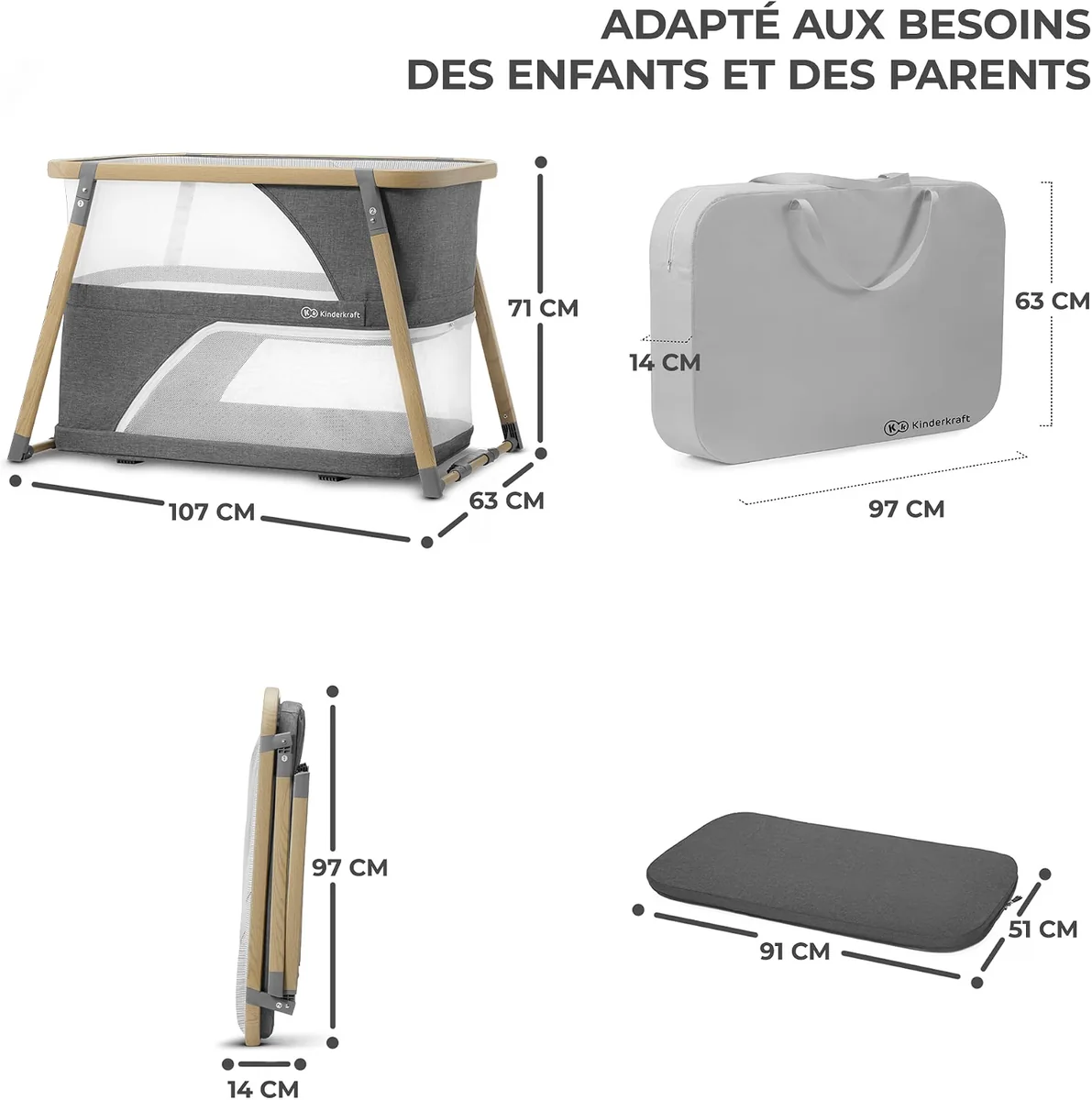
The fitted sheet is part of the mattress: it must be the exact size, pulled taut, with no creases. A sheet that is too big forms folds, and a tucked-in flat sheet can come loose. For the Kinderkraft Sofi, whose mattress measures about 91 x 52 cm, the 60 x 120 cm sheets made for classic travel cots are too big. See our article travel cot mattress and sheets.
An empty cot
Nothing in a baby’s cot apart from baby in their sleeping bag:
- no pillow or cushion;
- no duvet, blanket or quilt;
- no cot bumper, even a “breathable” one;
- no sleep positioner, sleep nest or reducer;
- no soft toys, toys or mobile within reach;
- no sheepskin, towel or fleece laid over the sheet.
Sante.fr states that sleep nests and hammocks are not allowed before 6 months. A French local safety guide simply declares them forbidden. In a travel cot, the mesh already acts as a soft wall: a bumper serves no purpose and reduces air flow.
Sleeping bag and temperature
The sleeping bag replaces the blanket: baby cannot pull it over their face or wriggle out of it. Choose one in baby’s size, so that their head cannot slip inside, and with a tog rating suited to the season. Prevention leaflets advise against over-wrapping baby: a comfortable room and a suitable sleeping bag are better than an overheated room.
Never cover the travel cot with a sheet or blanket for shade or insulation. The mesh must stay clear for ventilation.
Share the room, not the bed
Recommendations agree: baby sleeps in the parents’ room for the first months, but in their own cot. Health Canada recommends placing the cot in the room for the first six months. Brochures from the US National Institutes of Health point the same way, recommending room sharing, but not bed sharing, for at least the first six months.
A travel cot suits this arrangement well. It should not be pushed against or attached to the parents’ bed, unless it is designed as a bedside sleeper. Nor should baby sleep in an adult bed, on a sofa or in an armchair, with or without an adult.
A smoke-free environment
Safe sleep advice everywhere includes a smoke-free environment, during pregnancy and after the birth. That does not only concern the bedroom: smoke clings to clothes, fabrics and upholstery, including the fabric of a travel cot that travels in a car or stays in a home where people smoke. If someone in the family smokes, they should do so outside only, never in the car with baby and never in the room where baby sleeps. At the grandparents’ or in a holiday rental, it is worth raising the subject openly. Your GP or local stop smoking service can help anyone who wants to quit.
Standards for folding cots and playpens
Two European standards cover these products:
- EN 716: cots and folding cots for domestic use. Part 1 sets the safety requirements, part 2 the test methods. Several manufacturers list the EN 716-1/2:2017 version.
- EN 12227: playpens for domestic use.
These standards cover in particular the stability of the cot, the strength and effectiveness of the locking systems, safety dimensions and the absence of trap points for fingers, head or limbs. A cot that is also a playpen should ideally meet both. Kinderkraft gives EN 716-1:2017 and EN 12227:2010 for the Sofi.
A standard guarantees the design, not the use: a compliant cot that is badly assembled, with an added mattress or objects in the sleeping area, is no longer a safe cot.
What to check when buying
- A safety compliance statement on the product or packaging.
- The name or brand of the manufacturer or importer, and their address.
- The model reference, for sheets, parts and any recall.
- Instructions in English, with the warnings and limits of use.
- The EN 716 standard, plus EN 12227 if the cot is also a playpen.
- The child’s maximum weight.
Be wary of a cot sold without instructions in English, with no identifiable brand, or whose listing gives no weight limit.
Assembly and locking
Most incidents involving folding cots come from a cot that was not properly locked. The key steps:
- Read the instructions before the first assembly, and do a trial run at home.
- Unfold the cot fully until it reaches its stops.
- Check each lock: press on the top rail of each side; nothing should give.
- Put the mattress in only once the frame is locked.
- Check stability: the cot should not tip when you lean on one side.
On a classic bundle-fold travel cot, the top rails lock before you push down the centre of the base. On a flat-folding cot like the Sofi, the legs spread out to their open position. In every case, never put a child in a cot with even one lock you are unsure about.
Where to place the cot
- on a flat, stable floor;
- away from windows, and never under a window;
- away from radiators and heat sources;
- no cords nearby: blinds, curtains, lamp, baby monitor, sound machine, as Health Canada lists;
- at a distance from furniture and objects the child could grab or use to climb;
- in a smoke-free place.
Health Canada sums up a useful rule: decorate the room, not the cot. Mobiles, garlands and frames stay out of reach.
High level and low level
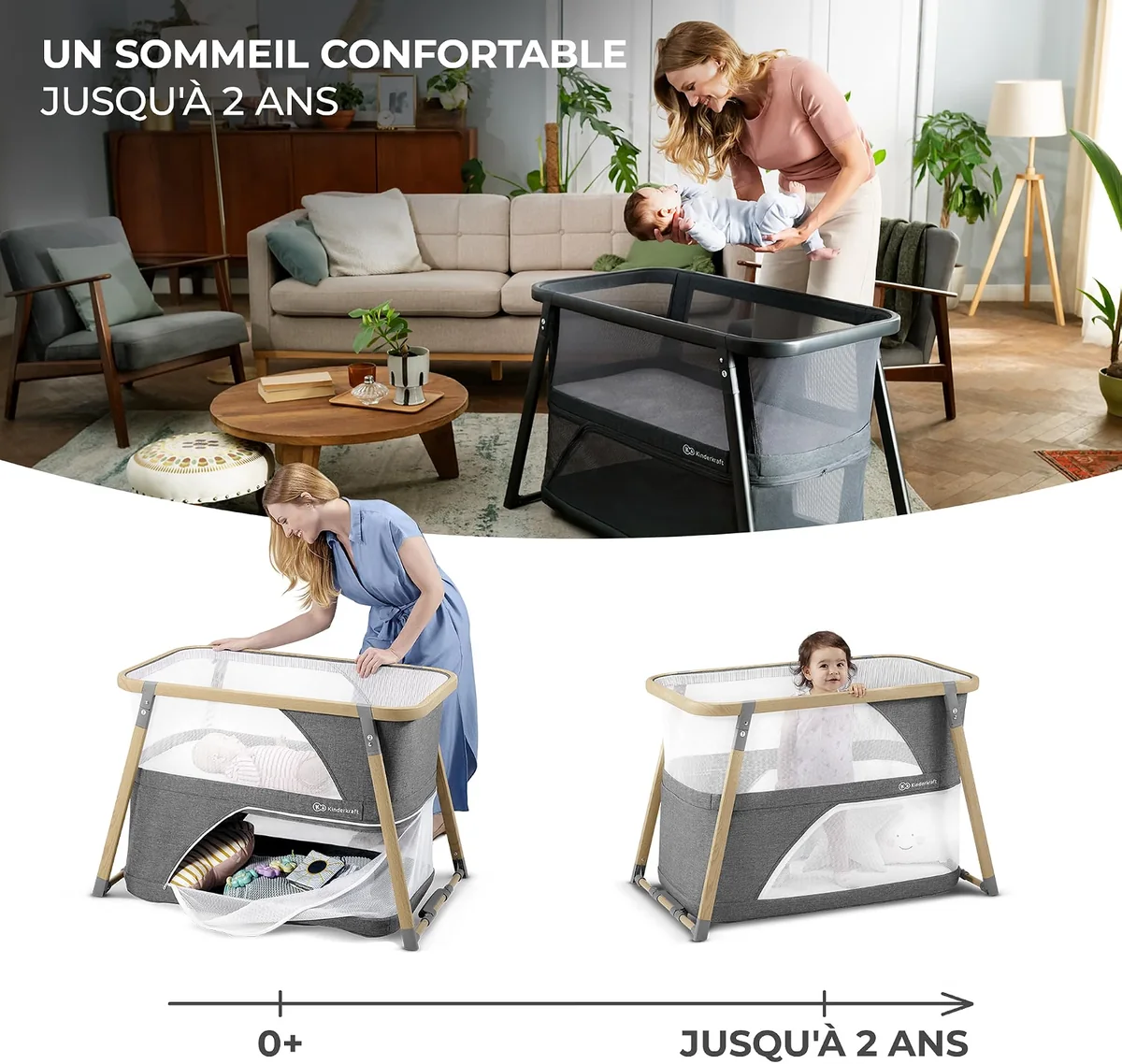
Many recent folding cots offer a raised level for the first months. It is a real comfort, with a strict rule: the high level is only for babies who do not roll or push up, and below the manufacturer’s weight limit. As soon as baby rolls, pushes up on their arms or sits, the mattress moves to the low position.
For the Sofi, a test published by a British magazine gives 9 kg for the high level, and a retailer says to lower the mattress as soon as the child starts to sit up. On a classic cot with a bassinet insert, the insert comes out at the same stage. Our calculator suggests the right level.
Rocking and playpen mode
The rocking function is a settling aid: rock, then lock the feet again as soon as baby is asleep, and always before leaving the room. Stop using it once the child starts to pull up.
Playpen mode, with a side opening, is a supervised play space. The opening must be closed for every nap and night, and the mattress in the low position for play. Play toys come out of the cot before sleep.
Weight and age limits
Every cot has a weight limit set by the manufacturer: 15 kg for the Sofi. Some manufacturers also use a developmental criterion: the cot is no longer suitable once the child starts climbing out. Both limits apply, and whichever comes first decides.
When the child is nearing the limit, or makes their first attempts to climb, it is time to move to a child’s bed. Never remove a part of the cot to “make it last”, and do not raise the sides with an accessory not designed for it: the DGCCRF reminds parents never to change the design or intended use of a nursery product.
Regular checks
| When | What |
|---|---|
| Every time it is set up | All four sides locked, stability, feet locked, zip closed |
| Every bedtime | Mattress flat, sheet taut, cot empty, right mattress level |
| Every month | Mesh with no holes or pulled threads, seams, zip, cover |
| Every season | Joints, rivets, rubber feet, carry bag |
| After a flight in the hold | Frame not bent, locks intact |
If a part is damaged, stop using the cot. The DGCCRF advises against repairing a nursery product yourself and recommends contacting the manufacturer’s after-sales service.
Second-hand and borrowed cots
A second-hand or borrowed travel cot can be perfectly safe, as long as you check:
- The model can be identified and the instructions are available.
- The mattress is the original, in good condition.
- The locking is firm, with no play and no home-made parts.
- The mesh and seams are intact.
- The model has not been recalled: check the EU Safety Gate portal or your national product safety authority’s recall list.
A cot without its original mattress, repaired at home, or very old with no reference, is not a bargain.
Recalls and reporting
In the European Union, dangerous product alerts are published on the Safety Gate portal, and in the UK the Office for Product Safety and Standards publishes product recalls. If you notice a defect on a cot (a lock that gives way, a broken part, mesh that tears), stop using it, contact the manufacturer, and report the problem to your national consumer or product safety authority; in the UK, Citizens Advice passes reports on to Trading Standards. These reports help the authorities spot dangerous products.
In an emergency
If your child has difficulty breathing, is not responding normally, is trapped or injured, call 999 (or 112). For a non-urgent question about baby’s sleep, your GP, your midwife or your health visitor are the right people to ask, and NHS 111 can help outside surgery hours. Learning paediatric first aid is an excellent idea for every adult who looks after a young child.
Safety myths
| Myth | The reality |
|---|---|
| “On their back, they may choke if they bring up milk” | Recommendations call for back sleeping for all healthy babies. If there is doubt because of a medical condition, it is the doctor’s decision. |
| “A thicker mattress is more comfortable, so better” | Firmness is part of safe sleep. Adding a mattress is considered dangerous in a travel cot. |
| “A bumper stops them banging their head” | The mesh already does that. Bumpers should be avoided. |
| “A comforter reassures them” | Recommendations say to put nothing in a young baby’s cot. Ask your GP or health visitor from when a small comforter can be introduced. |
| “A travel cot is less safe than a full-size cot” | A compliant folding cot, properly assembled and used, is a safe place to sleep. Mistakes in use make the difference. |
| “They need covering so they do not get cold” | A sleeping bag suited to the season replaces any blanket. |
| “It is fine to let them sleep in the car seat” | A car seat or a pushchair is not a bed: move baby to a flat sleeping surface as soon as you can. |
Accessories to avoid
The nursery market offers many accessories presented as aids to sleep. In a travel cot, most of them should be avoided:
- Sleep positioners and wedges, meant to keep baby on their back or side.
- Sleep nests, pods and reducers placed in the cot: sante.fr points out that sleep nests are not allowed before 6 months.
- Cot bumpers, including mesh or “breathable” ones.
- Mattress toppers and extra mattresses not provided by the cot’s manufacturer.
- Blankets, duvets and pillows, even small ones.
- Sheets draped over the cot for shade or darkness.
- Mobiles and hanging toys within reach.
On the other hand, a few accessories are useful if well chosen: fitted sheets in the exact mattress size, a sleeping bag that fits baby, a baby monitor whose cable stays out of reach, a mosquito net designed for the cot and pulled taut.
Baby monitors and cameras
An audio or video baby monitor can be reassuring, especially when baby naps in another room. Its main risk in a travel cot is the cable: place the monitor and its lead well out of reach, never on the edge of the cot or hanging over the mesh, and do not use a camera mount clipped to the cot unless the manufacturers of both products say it is compatible. Movement and breathing monitors are sold to many parents, but the US paediatric recommendations state that they should not be used as a way of reducing the risk of sudden infant death. A monitor never replaces the basics: back sleeping, a firm original mattress, an empty cot and a shared room in the first months.
Passing the rules on to everyone who puts baby to bed
Safe sleep rules only work if every adult who puts baby to bed follows them: parents, grandparents, babysitter, aunts and uncles, friends looking after the child for an evening. The US National Institutes of Health brochure stresses this point: a baby used to their back who is put on their tummy just once is particularly at risk.
A few ideas to help the rules stick:
- a short note by the cot with the five key rules;
- a demonstration of assembly, locking and putting baby down, the first time;
- a one-sentence explanation of why each rule matters;
- the instructions left with the cot.
Our article the travel cot at the grandparents’ includes a template note to print.
The bedtime checklist
Before each bedtime, a few seconds are enough to check the essentials:
- The cot is locked on all four sides.
- The mattress is the right one, on its own, flat, at the right level.
- The fitted sheet is taut and the right size.
- The cot is empty: no toys, cushions or linen.
- The zipped opening is closed, the feet locked.
- Baby is on their back, in their sleeping bag, no hat.
- Nothing is within reach: cords, cables, curtains, objects.
- The room is comfortable and smoke-free.
This routine soon becomes second nature. It protects baby, and it reassures parents.
Preventing falls and climbing
Once the child can stand, the risk changes: it is no longer the sleeping surface that is the issue, but falling. A child who grips the sides, lifts a leg or hauls themselves up can tip over the top. A few rules:
- Mattress in the low position from the first rolls, well before the child can stand.
- Nothing in the cot that could be used as a step: large toys, cushions, the carry bag.
- Nothing around the cot to climb on: a chair, a box, a bedside table pushed against the cot.
- Zipped opening closed for sleep, so the child does not get out alone at night.
- Stop using it at the first climbing attempts, even below the weight limit.
Some travel cot manufacturers use climbing as a limit of use: the cot is suitable from birth to about three years, or until the child starts climbing out. For the Sofi, Kinderkraft sets the limit at 15 kg: the stricter of the two limits applies.
Safety away from home
Most risky situations happen away from home, in surroundings you do not control: a hotel room, a rental, a family house. Before the first night, walk round the room at child height:
- Windows: closed or locked, cot at a distance.
- Cords: blinds and curtains tied up high, cables out of reach.
- Heating: radiator, heater or air conditioning away from the cot.
- Small objects: medicines, coins, button batteries, plastic bags put away.
- Furniture: nothing unstable or climbable near the cot.
- Cot provided: checked like your own, single mattress, intact mesh.
These checks take five minutes. They prevent most unpleasant surprises, and they apply to every adult who puts baby to bed.
Managing worry
Reading safety rules about baby’s sleep can be worrying, especially in the first weeks. Keep one thing in mind: these rules are simple, and they work. According to a US National Institutes of Health brochure, the campaigns for back sleeping, together with public awareness, helped halve sudden infant death rates in the United States. A baby on their back, in a compliant, empty cot, on a firm, well-fitting mattress, in their parents’ room, is sleeping in the recommended conditions.
There is no need to get up ten times a night to check they are breathing, or to buy sophisticated monitoring devices. If worry is stopping you sleeping or enjoying these first months, talk to your midwife, your GP or your health visitor: that is part of what they are there for.
Heat, sun and draughts
A baby is not good at regulating their temperature. An overheated room or a cot set up in the sun behind a glass door should be avoided, as should a cot placed in a cold draught. Dress baby according to the room temperature, with a sleeping bag suited to the season and no hat indoors. Never cover the cot with fabric for shade: the mesh must stay clear so air can circulate. In summer, air the room in the cool hours and close the shutters or curtains during the day. In winter, keep the cot away from radiators and cold windows.
The Kinderkraft Sofi
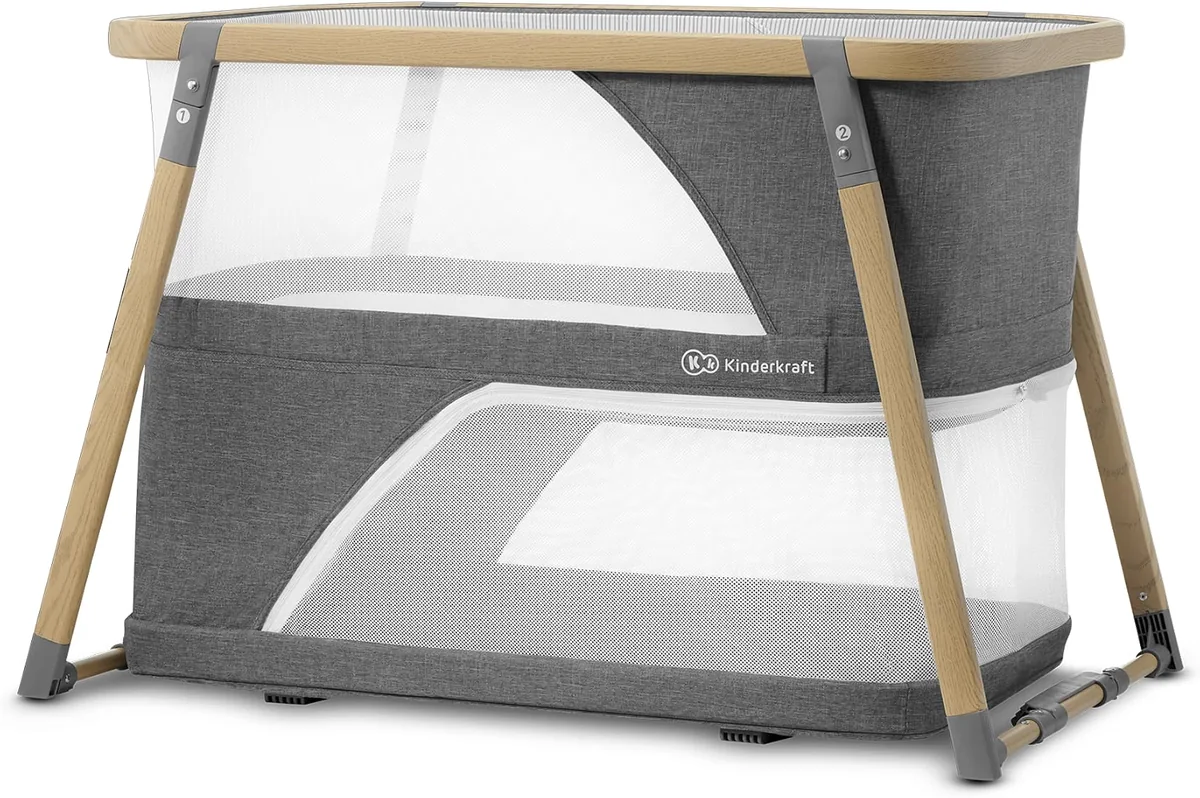
The Sofi lists the EN 716-1:2017 and EN 12227:2010 standards, comes with its mattress, and offers a raised level, lockable rocking and a zipped opening for playpen mode. As with any folding cot, its safety also depends on how it is used: original mattress only, sheets in its size, an empty cot, feet locked at night, low level as soon as baby pulls up. Our user guide goes through these steps.
Frequently asked questions
Is a travel cot safe for a young baby?
Yes, if it complies with standards, is sold as suitable from birth, is properly assembled with its original mattress, and baby sleeps on their back with nothing around them.
Why should I not add a mattress?
An added mattress makes the surface softer and creates gaps at the sides. French guidance considers it dangerous in a travel cot.
Is a bumper useful in a travel cot?
No. The mesh already acts as a soft wall, and bumpers should be avoided.
Which standard should a travel cot list?
EN 716 for folding cots, plus EN 12227 if it is also a playpen.
How do I find out if a cot has been recalled?
Check the EU Safety Gate portal or your national recall list, using the brand and model reference.
How long can a travel cot be used?
Up to the manufacturer’s weight limit, or earlier if the child starts climbing out.
The articles in this section
Ready for the first nights?
4-in-1 · From birth to 15 kg · Mattress included · Travel bag. Prices and colours change often on Amazon: check them, along with the seller and the exact model (Sofi or Sofi Plus), before ordering.
Check the price on AmazonAffiliate link · new tab