How to choose a travel cot: the complete guide
Maximum weight, sleeping area, mattress, heights, folding, size: a travel cot is chosen on a dozen criteria, and above all on how you will use it. Here is how to weigh them, in order.
Contents
Start from the use, not the product
The first mistake when looking for a travel cot is to compare models before knowing what it will be used for. A cot that will sleep in a cupboard eleven months a year does not have the same requirements as a cot that will be used every evening in the parents’ bedroom for six months, or one that will fly three times a year. Before opening a single product listing, answer four questions.
- Where will the cot spend most nights? At home, at the grandparents’, at the childminder’s, in a holiday rental, in a hotel.
- How often will it be set up and folded? Once a year, every weekend, or never: some cots stay set up permanently in a spare room.
- How will it travel? In a big boot, in a small boot that is already full, in an aircraft hold, on a train, on foot for a few hundred metres.
- From when, and until when? From birth, or for a child who can already sit? For a few months or up to three years?
These four answers already sketch out your cot. Use from birth in the parents’ bedroom calls for a raised mattress. Frequent flights call for a light, compact cot. A cot that stays at the grandparents’ must be simple to understand and stable. A cot used up to three years needs a big enough sleeping area. Few cots tick every box, and that is normal: the point is to choose the boxes that matter to you.
The main families of folding cots
The term “travel cot” now covers several families of products that look alike in photos but not in use.
| Family | Typical use | Sleeping area | Weight |
|---|---|---|---|
| Classic travel cot | Spare cot, weekends by car | Often 60 x 120 cm, on the base | Often 7 to 10 kg |
| Travel cot with bassinet insert | From birth, then spare cot | 60 x 120 cm, removable high level | Heavier than the classic |
| Flat-folding 4-in-1 cot | Bedroom in the early months, weekends, grandparents | Varies, sometimes more compact | Around 8 to 9 kg |
| Ultralight travel cot | Flying, small spaces | Varies, often on the floor | Around 6 kg or less |
| Travel bassinet | First months only | Small, low weight limit | Light |
The weights and sizes in this table are orders of magnitude taken from retailers’ listings: they vary from model to model. Our article travel cot, playpen or bassinet details each family.
Age and the child’s maximum weight
On product listings, age takes centre stage: “from birth to 3 years”. That figure is only a guide. What counts is the child’s maximum weight set by the manufacturer, which is part of the cot’s safety conditions. For most folding cots it is around 15 kg. Some manufacturers do not give a weight limit and use a developmental criterion instead: the cot is no longer suitable when the child starts to climb out of it. Both limits apply, and whichever comes first prevails.
Think about the start of the period too. A cot sold as suitable from birth must be able to take a newborn lying flat, on a firm mattress that fits. Cots that are not designed for this say so in their instructions: read them before buying if you plan to use the cot for a very young baby.
To see at a glance how much margin your child has left, our calculator compares their weight with the 15 kg limit of the Kinderkraft Sofi.
The size of the sleeping area
The sleeping area determines two things: the child’s comfort as they grow, and the choice of sheets. The most common size for classic travel cots is 60 x 120 cm. That is a true cot size, in which a two- or three-year-old can sleep stretched out and turn over.
More compact cots, such as flat-folding cots or travel cots, often have smaller sleeping areas. The Kinderkraft Sofi, for example, has a mattress of about 91 x 52 cm according to retailers. That is plenty for a baby, tighter for a two-and-a-half-year-old who sleeps like a starfish. Parents who bought it say so: the cot is smaller than a classic travel cot and needs sheets to match.
To decide, think about duration. If the cot is used mostly in the first year, a compact sleeping area is no problem. If it has to take a three-year-old for whole holidays, a 60 x 120 cm area is more comfortable.
The mattress supplied
This is the most important criterion, and the most misunderstood. A travel cot mattress is designed for that specific cot: it fits the base, with no gap along the sides, and it is firm. French safe sleep recommendations ask for a firm mattress, fitted to the cot’s dimensions, covered with a well-fitted sheet. They also state that adding a mattress to a travel cot is dangerous.
The quality of a folding cot mattress is therefore judged on its firmness, its fit and its cover, not on its thickness. A mattress that looks thin is not a safety defect. A mattress that sinks under your hand, leaves a gap along the sides or has a cover that cannot be washed is. Check:
- whether it is supplied with the cot or sold separately;
- its exact size, for sheets;
- what its cover is made of, and whether it comes off for washing;
- whether it fits at one or more levels;
- whether the manufacturer offers a replacement mattress designed for this cot.
On the Sofi, the mattress is supplied, with a cover whose top is cotton, removable and washable at 30 °C, and fits at two levels. Parents generally describe it as comfortable and firm. See our article travel cot mattress and sheets.
Golden rule: never a second mattress, a mattress topper, a folded duvet or a cushion at the bottom of a travel cot. If the original mattress is unsuitable, ask the manufacturer for a replacement mattress designed for your model.
Adjustable height
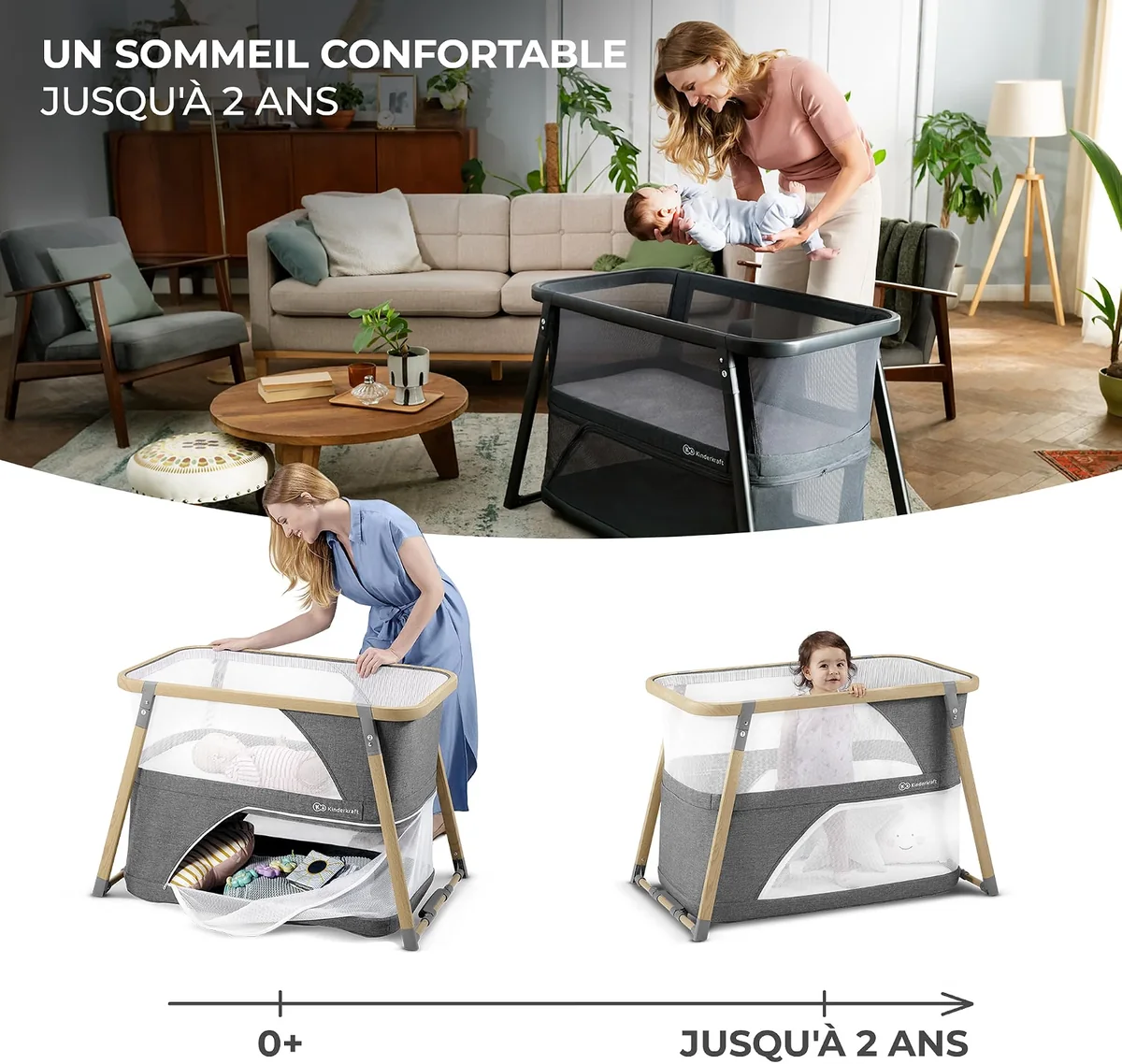
A classic travel cot puts the mattress almost on the floor. To lay down a sleeping newborn, you have to bend very low, arms outstretched. That is uncomfortable, especially after a birth, and it often wakes baby. A high level raises the sleeping surface to hip height during the first months.
Two systems exist. Some classic cots offer a “bassinet insert” or “newborn level”: a kind of rigid hammock that hooks onto the top of the cot and on which the mattress is laid. Others, like the Sofi, let you hook the mattress itself at the top. In both cases, the high position has a limit: it is for babies who do not roll over or pull up. For the Sofi, a review published by a British magazine gives 9 kg, and a retailer specifies lowering the mattress as soon as the child starts to sit up.
If you plan to use the cot from birth in your bedroom, this criterion comes first. If the cot is for a child who can already sit, it becomes secondary. Our article travel cot from birth covers this period in detail.
The folding mechanism
A travel cot is often set up and taken down in poor conditions: late in the evening, in an unfamiliar room, with a tired baby in someone’s arms. The mechanism must therefore be simple, but above all readable: you should see and feel that the cot is locked.
Bundle fold (umbrella style)
- You pull the centre of the base up and the sides come together
- Short, thick folded format
- Top rail locks to check
- Sometimes confusing at first
Flat fold
- You fold the legs like those of a folding table
- Long, very slim folded format
- Often a more intuitive move
- Slides under a bed or against a wall
Parents’ feedback on classic travel cots often makes the same point: folding is not always intuitive at first and takes some getting used to. A published review of the Sofi highlights the opposite, an instant unfolding that grandparents baffled by a classic travel cot could manage. If the cot will often change hands, this criterion weighs heavily.
Either way, do a first set-up at home, calmly. You will know where the locks are and how they release.
The weight of the cot
Classic travel cots and 4-in-1 cots often weigh between 7 and 10 kg according to retailers’ listings. Ultralight travel cots come down to around 6 kg or less. The Sofi weighs 8.7 kg according to Kinderkraft.
This figure matters mainly if you carry the cot any distance: from a station to a hotel, from a car park to a seaside rental, up the stairs of a block of flats. For a cot that goes from the boot to the bedroom, 2 or 3 kg of difference is barely noticeable. For a cot that flies with a tight baggage allowance, it is very noticeable.
Folded dimensions
A travel cot spends most of its life folded. Its folded dimensions are therefore to be compared with where it will live: your car boot, a cupboard, the space under a bed, the buggy store.
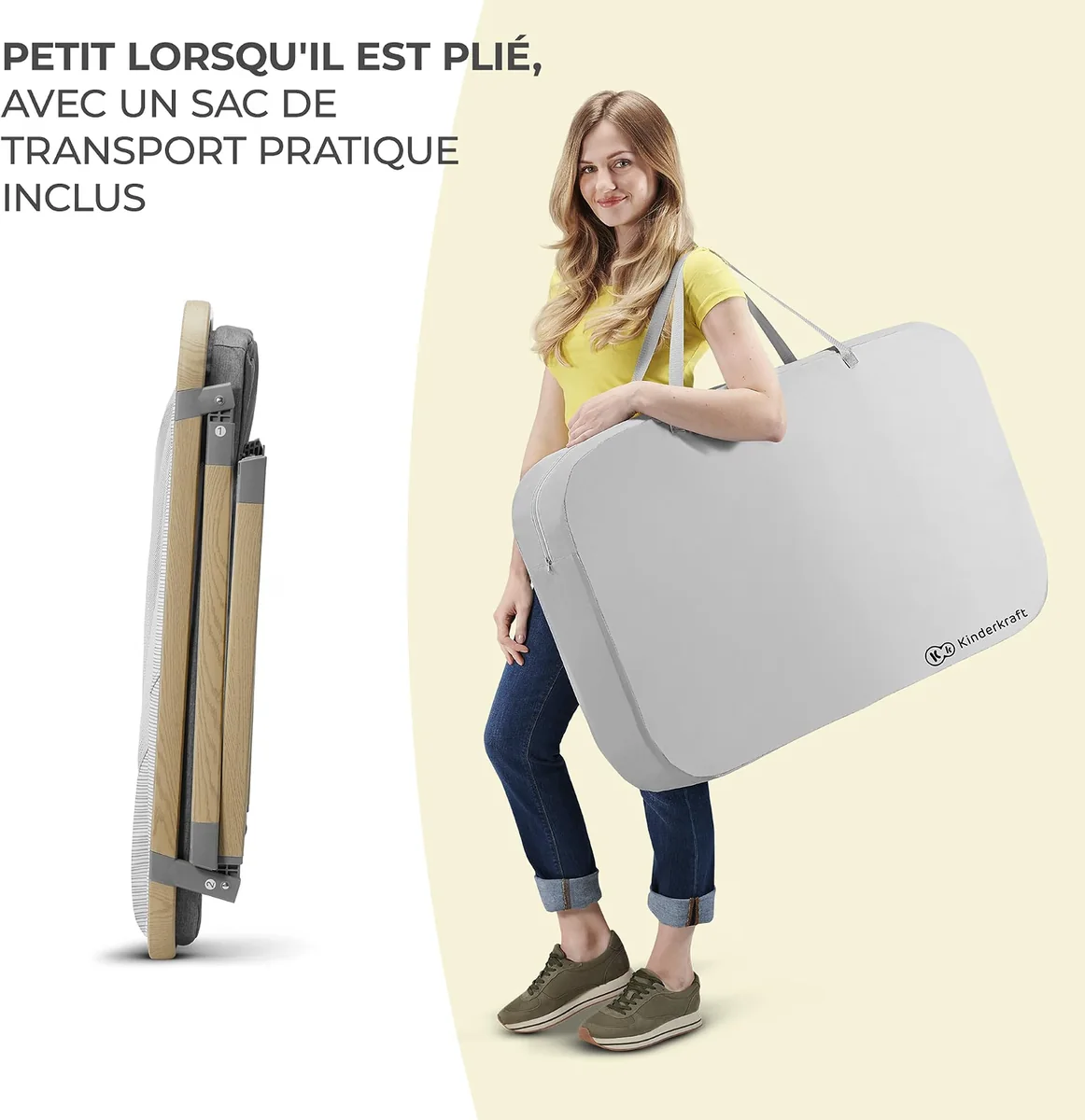
Bundle-fold cots are often short (around 75 to 80 cm according to listings) but thick. Flat-fold cots are slim but long: the folded Sofi measures 97 x 63 x 14 cm. That format is ideal under a bed or flat on the floor of a big boot. In a small boot, it is the length that gets stuck.
Measure the inside of your boot at the narrowest point, between the wheel arches, and the clearance under the parcel shelf. Our calculator then compares the three dimensions of the folded cot with your space, in every orientation.
Mesh, fabric and airflow
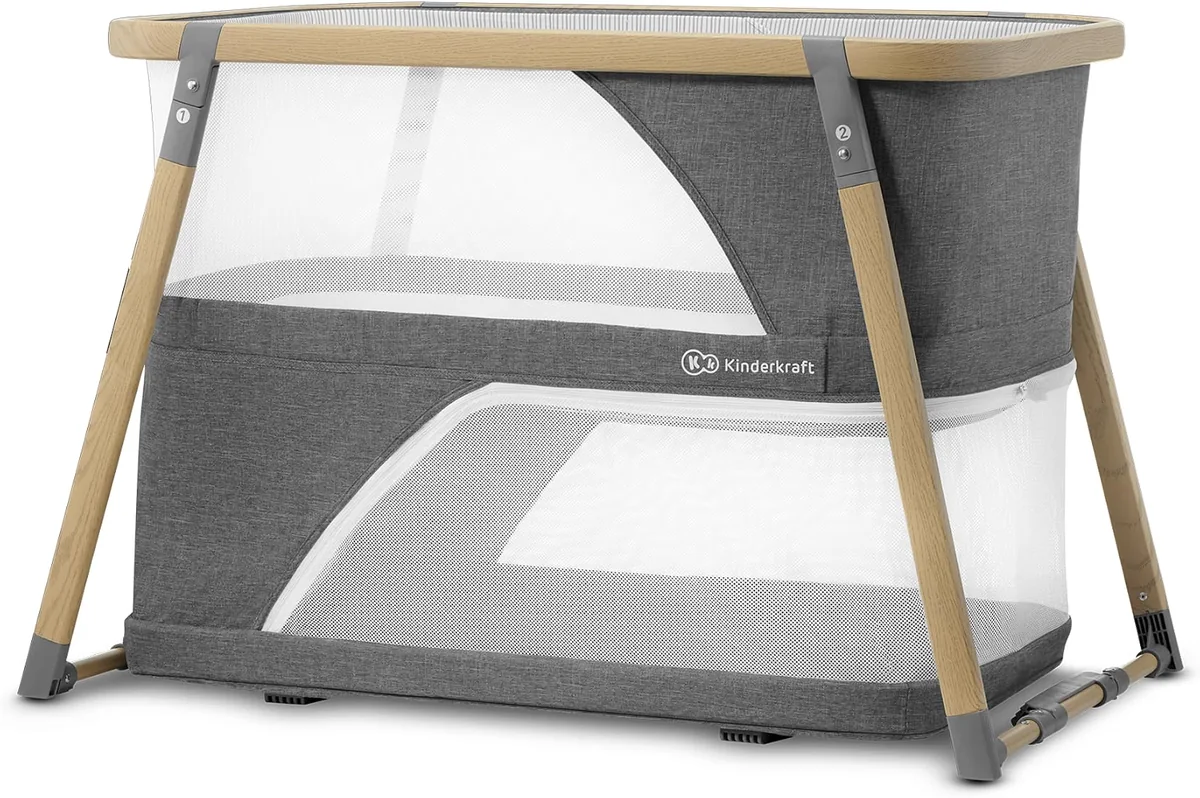
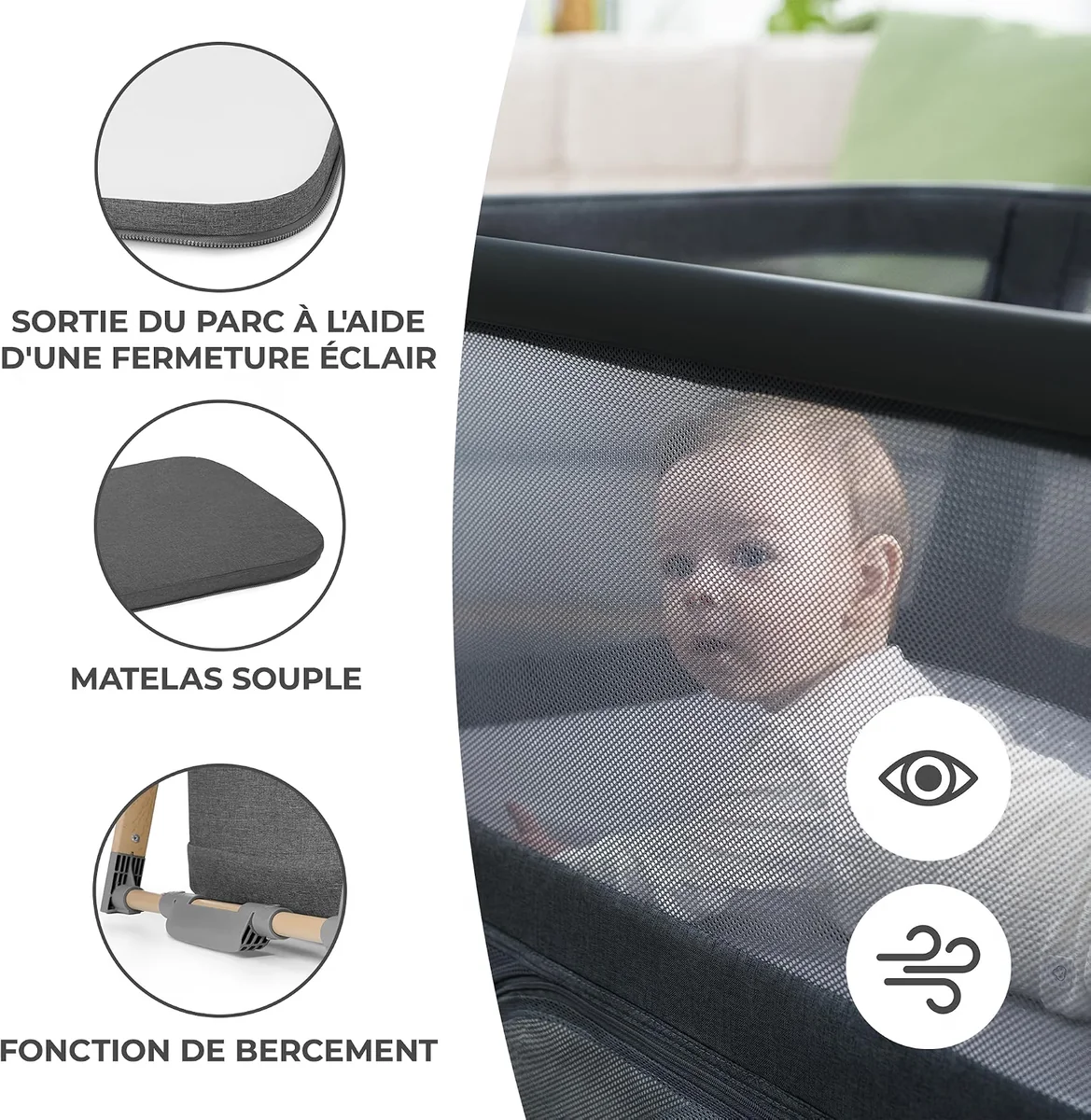
Mesh sides have become the norm, for two reasons. They let you see baby without going into the room, and they let air circulate. Check that the mesh covers at least the long sides, and ideally the head and foot ends. On the Sofi, large panels of white mesh cover the sides, with grey fabric at the corners; the Sofi Plus, according to one parent, has nothing but mesh around baby.
Look at the quality of the mesh too: tight, soft, with no loose threads, sewn without bulky seams on the inside. Mesh that is too loose or damaged can catch small fingers. Torn mesh means you must stop using the cot and contact the after-sales service.
Side opening and playpen mode
Many folding cots can also serve as a playpen. On some, it is simply the cot used during the day with toys. Others, like the Sofi, have a zipped opening on one side: a panel folds down and the child can get in and out alone. That is handy for a child who crawls and likes to have “their own little house”.
Two rules with this type of opening: it stays closed for every nap and night, and the mattress is in the low position when the cot is used as a playpen. A cot that doubles as a playpen does well to display EN 12227, the playpen standard, as well as the cot standard.
Rocking, wheels and accessories
Product listings compete on accessories: play arches, musical mobiles, removable changing tables, side storage, wheels, mosquito nets, rocking function. Some are useful, others add weight and complicate folding.
- Rocking helps settle a very young baby. Lock it again once baby is asleep.
- Wheels make moving the cot around the house easier. Check that they lock firmly.
- A changing table is handy on weekends away, but must be removed before putting baby to sleep.
- Arches and mobiles are play toys: remove them for sleep.
- The carry bag is essential if the cot travels. Check that it is included.
The Sofi opts for simplicity: no changing table or mobile, but rocking, a playpen mode and a bag. That is a good thing for a cot that needs to fold quickly.
Standards and mandatory labelling
The reference European standard is EN 716, which covers cots and folding cots for domestic use. It has a safety requirements part (EN 716-1) and a test methods part (EN 716-2). For a cot that also serves as a playpen, EN 12227 completes the picture. These standards cover in particular stability, the strength of the locks, safety dimensions and the absence of trapping points.
In France, a childcare product must also carry the statement “Conforme aux exigences de sécurité” (complies with safety requirements), the identity of the manufacturer or importer, and instructions with warnings in French. Wherever you are, be wary of a cot sold without instructions in your language, without an identifiable brand, or with instructions only in another language. Kinderkraft states EN 716-1:2017 and EN 12227:2010 for the Sofi.
Care and durability
A well-chosen travel cot often serves several children, or passes from one family to another. Look at:
- whether the mattress cover comes off and goes in the machine (the Sofi: 30 °C according to Kinderkraft);
- whether the fabric of the sides is easy to clean;
- the quality of the joints, rivets and feet;
- whether there is a sturdy bag for storage;
- the availability of after-sales service and spare parts;
- the warranty: your statutory rights, and possibly a manufacturer’s extension (Kinderkraft mentions an optional extension of up to 10 years, subject to conditions).
Our article travel cot cleaning and care details the right habits.
Looks matter too
It is rarely said, but the look of a travel cot matters when it stays in a bedroom for months. Classic cots in bright colours with big fabric panels look like camping gear. Recent models, with a light or wood-effect frame and marl fabrics, blend better into an adult bedroom. Parents who chose the Sofi often mention its look among its qualities. It is not a safety criterion, but it is a satisfaction criterion.
New or second-hand?
Travel cots lend themselves well to the second-hand market: there are plenty, little used. A few checks are essential:
- The model and brand are identifiable, with the instructions (or a downloadable version).
- The mattress is the original, in good condition, not sagging.
- Set-up and locking are clear, with no play and no improvised parts.
- The mesh is intact, with no holes or pulled threads, and the seams hold.
- The cot has not been recalled: check the EU Safety Gate portal or your national product safety authority’s recall list.
The French consumer safety authority (DGCCRF) advises never modifying a childcare product and not repairing a damaged part yourself. A second-hand cot repaired at home or sold without its original mattress is not a bargain.
Product listing traps
- “Up to 3 years” with no maximum weight: ask for the weight limit.
- “Comfortable mattress” with no dimensions or composition: ask for the exact size.
- “One-second fold”: watch a manufacturer video and check the locking.
- “Lightweight” with no figure: compare the kilos, bag included.
- “From birth” with no high level: it may well be, but you will be bending down to the floor.
- Accessories shown in photos but missing from the box: read the contents list.
- Two similar models with similar names (Sofi and Sofi Plus, for example): check the exact name.
Budget: where to spend the money
Travel cots cover a wide price range, from entry-level models sold in supermarkets to high-end travel cots. We do not display prices on this site, because they change often, but we can say where money makes a difference, and where it changes nothing.
What justifies paying more
- A built-in high level, if you will use it from birth
- A simple, readable fold, if the cot travels often
- Lower weight, if you fly
- A removable, washable mattress cover
- Reachable after-sales service and available parts
What changes nothing for safety
- Mobiles, play arches and music boxes
- Colours and patterns
- Accessories you will remove for sleep
- A “thicker mattress” sold as a selling point
An entry-level cot that complies with EN 716, with its original mattress and used properly, is a safe place to sleep. Paying more buys convenience, versatility or lightness, not extra safety. Think in terms of duration too: a 4-in-1 cot that replaces a crib and a playpen may cost more to buy and less overall.
Finally, think about extra costs: fitted sheets in the right size, sleeping bags, perhaps a travel cover for the hold. For a cot with a non-standard size, dedicated sheets can be harder to find: include them in your budget from the start.
The checklist in store or on delivery
Whether you see the cot in a shop or receive it at home, make these checks before the first night:
- The box is complete: frame, mattress, bag, instructions in your language, accessories advertised.
- The labelling is there: EN 716 standard, brand and reference, safety warnings.
- Set-up is clean: each lock clicks firmly into place, the cot does not move when you lean on it.
- The mattress fits: flat, with no gap along the sides, in every position provided.
- The mesh is intact: no pulled threads, even seams, nothing sharp inside.
- It folds without forcing, and the cot fits in its bag.
- The smell is bearable: if the cot smells strongly new, leave it open in a ventilated room before use.
If something is wrong, use your right to cancel within fourteen days for an online purchase, or your statutory rights against the seller.
Baby list or buy later?
The travel cot is on many baby lists. If you plan to use it from the first weeks, in your bedroom, it must be there before the birth: set up, checked, with its sheets washed. If it is mainly a holiday cot, there is no hurry: you can choose it once you know your baby’s habits and your transport needs better. In both cases, add fitted sheets in the right size and two sleeping bags to the list: they are the classic forgotten items. And if several relatives want to chip in, a more complete cot, with a high level and a bag, is often a better gift than several small accessories.
Questions to ask before buying
When a listing leaves gaps, do not hesitate to ask the seller or the manufacturer’s customer service. Five questions settle most doubts: what is the exact size of the mattress, and is a replacement available? What is the child’s maximum weight, and is there a limit for the high level? Which standards does the cot meet, and is the reference visible on the product? What exactly is in the box? How long does after-sales support last, and are spare parts available? A seller who cannot answer these questions is a warning sign in itself.
Small flat: what matters
In a small city flat, every centimetre counts. A travel cot that stands in the parents’ bedroom needs room beside your bed without blocking the way out, and should stay well away from the window and the radiator. A flat-folding model can slide under a bed during the day when it is not needed, and be set up again in seconds in the evening. Here, a more compact sleeping area is often an advantage rather than a drawback. Before buying, measure the space you have both with the cot set up (Sofi: 107 x 63 cm) and folded (97 x 63 x 14 cm), and check that a door or wardrobe can still open fully.
The decision grid
| If you… | Prioritise | Matters less |
|---|---|---|
| Put baby to sleep in your bedroom from birth | Raised mattress, mesh, looks | Weight of the cot |
| Often travel by car | Simple fold, bag, folded size | Accessories |
| Often fly | Weight, compactness, hold bag | High level |
| Leave the cot at the grandparents’ | Simplicity, stability, big sleeping area | Weight, folded size |
| Want a daytime playpen | Side opening, EN 12227 standard | Rocking |
| Plan to use it up to 3 years | 60 x 120 cm sleeping area, weight limit | High level |
Where the Kinderkraft Sofi fits
The Kinderkraft Sofi answers the first three lines of this grid very well: two-height mattress, mesh, careful design, tool-free flat fold, bag supplied. It answers flying less well, at 8.7 kg and 97 cm long folded, and intensive use up to 3 years, with its sleeping area of about 91 x 52 cm. It is a bedroom and weekend cot more than an expedition cot. Our verdict page sums up what parents say about it.
Frequently asked questions
What is the most important criterion?
The use. Then the mattress supplied and the weight limit, then folding and the folded dimensions.
Is a travel cot without a high level suitable for a newborn?
Yes if it is sold as suitable from birth, but you will have to bend right down to the bottom. A high level is far more comfortable in the early months.
What size travel cot should I choose?
60 x 120 cm for use up to 3 years, a more compact size if the cot is used mainly in the first year or if you are short of space.
Should I buy an extra mattress?
No. Use the mattress supplied with the cot, and never add a second one.
How much should a good travel cot weigh?
It depends on the use: around 6 kg or less for flying, 8 to 10 kg for a complete cot carried by car.
Which standard should I check?
EN 716 for a folding cot, plus EN 12227 if it serves as a playpen, and clear identification of the manufacturer.
The articles in this section
Ready for the first nights?
4-in-1 · From birth to 15 kg · Mattress included · Travel bag. Prices and colours change often on Amazon: check them, along with the seller and the exact model (Sofi or Sofi Plus), before ordering.
Check the price on AmazonAffiliate link · new tab